AI Writing Assistants vs Full AI Blogging Platforms
Understand the difference between lightweight AI writing tools and end-to-end blogging platforms so you pick the right stack.

Understand the difference between lightweight AI writing tools and end-to-end blogging platforms so you pick the right stack.
Pranjal Jain
Choosing between an AI writing assistant vs AI blogging platform is no longer a nice-to-have debate. It defines how fast you ship content, how reliably you rank, and how much of your team’s time is locked in operational work vs strategy.
If you’re stuck wondering whether to keep stacking lightweight AI writing tools or move to a full AI blogging platform, this guide breaks it down in plain language. We’ll compare use cases, costs, workflows, and long-term ROI so you can pick the right stack for your content engine.
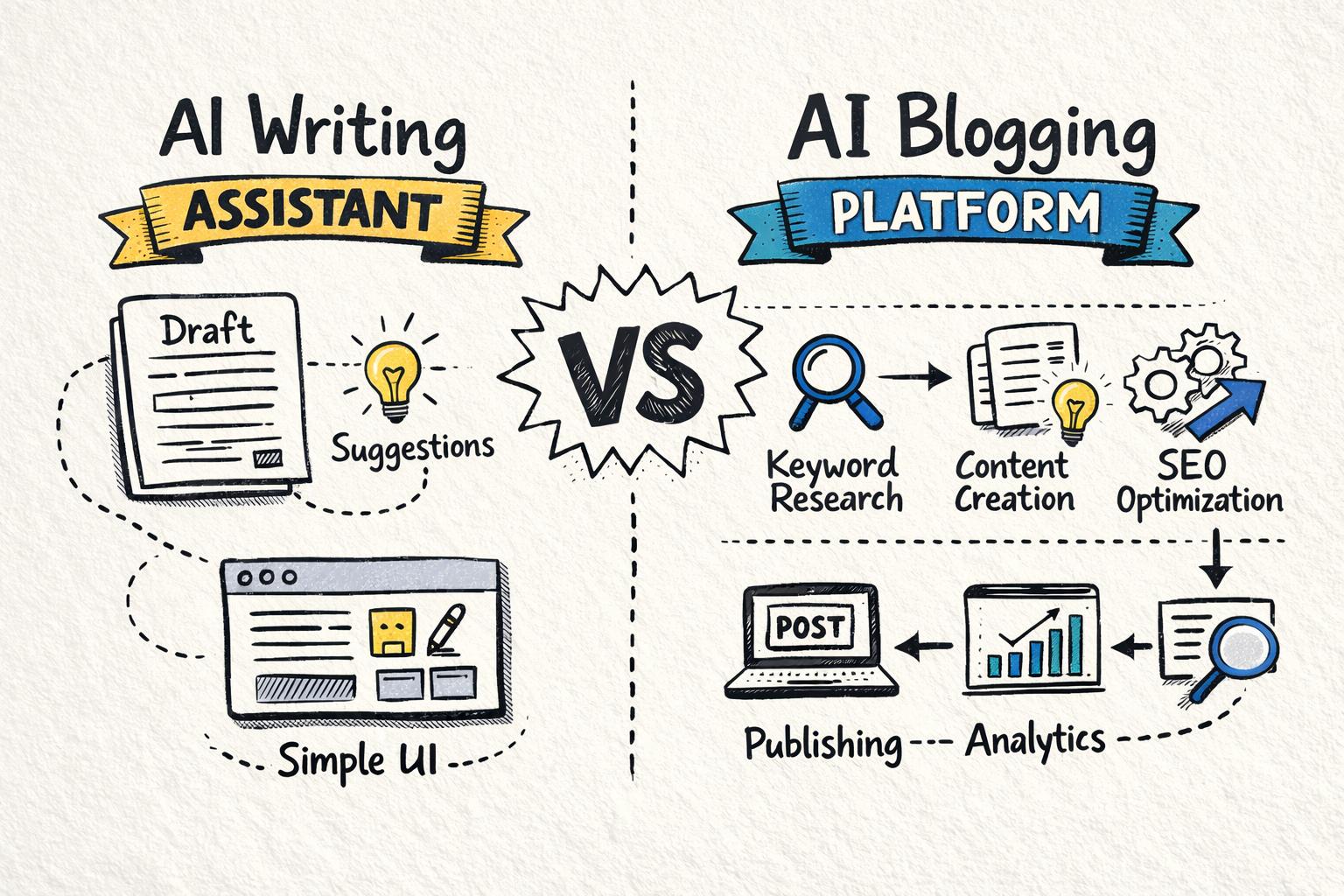
The simplest way to think about it:
AI writing assistants help you inside a single document (drafting, rewriting, fixing tone).
AI blogging platforms help you run the entire blog as a system (research → writing → optimization → publishing → analytics → iteration).
Both use similar underlying models, but they solve very different problems. One is a smarter text editor. The other is a content marketing operating system.
An AI writing assistant is typically a browser extension, web app, or editor integration that focuses on improving or generating text in the moment.
Autocomplete and paragraph generation
Grammar, spelling, and style suggestions
Rewriting sentences or paragraphs for clarity or tone
Summarizing long passages
Simple SEO suggestions (keyword mentions, readability)
Templates for emails, ads, social captions, or short-form copy
These tools shine when you’re working on one piece of text at a time and just need to move faster or sound more polished.
Low learning curve – feels like a smarter version of your current editor.
Great for ad hoc tasks – emails, LinkedIn posts, landing page tweaks.
Cheap or freemium – many tools start at low monthly prices.
Easy adoption – individuals can start using them without changing team workflows.
No built-in keyword research or topic pipeline.
Limited SEO strategy – they optimize text, not your overall content plan.
No publishing workflow – you still have to copy-paste into CMS, format, add images, and schedule.
No or minimal analytics – you can’t see what content actually drives traffic or leads.
Hard to scale as a team – everyone works in their own docs, with no shared pipeline.
For solo creators doing occasional blogging, an assistant can be enough. But once blogging becomes a core growth channel, the cracks start to show.
An AI blogging platform is built for teams and businesses that treat content as a growth engine, not a side project. Instead of just helping you write, it helps you run the whole SEO content operation.
Automatic keyword research and topic clustering
AI content generation for full, SEO-optimized blog posts
On-page SEO guidance (headings, internal links, meta data, structure)
AI image generation tailored to each article
Multi-platform publishing to WordPress, Webflow, Shopify, Framer, and more
Content calendar and workflow for teams and agencies
Performance analytics to track traffic, rankings, and conversions
Content refresh and rewriting for existing posts
Platforms like Supablog go further with features such as automated backlink exchange, multilingual generation (150+ languages), and YouTube video integration to help posts rank and engage better.
End-to-end workflow – from keyword discovery to live article, in one place.
Consistency at scale – same structure, tone, and SEO best practices across dozens of posts.
Massive time savings – teams can publish 10–30+ posts per month without hiring extra writers.
Measurable ROI – analytics and reporting make it clear what content works.
Team collaboration – shared calendars, drafts, and approvals instead of scattered docs.
Higher commitment – you’re adopting a system, not just a helper.
Higher price point than simple assistants (though often cheaper than hiring).
Best for serious blogging – overkill if you only publish a few posts a year.
Use this side-by-side comparison to see which category matches your needs.
Scope of work
AI writing assistant: Helps write and edit text inside a doc.
AI blogging platform: Manages the entire blog lifecycle (research → content → SEO → publishing → analytics).
SEO capabilities
Assistant: Basic keyword mentions, readability suggestions.
Platform: Keyword research, topic clustering, on-page optimization, and performance tracking.
Publishing workflow
Assistant: Manual copy-paste to CMS, manual formatting, media uploads.
Platform: Direct publishing to CMS (WordPress, Webflow, Shopify, etc.), with templates and consistent formatting.
Team collaboration
Assistant: Individual usage, no shared pipeline.
Platform: Shared calendars, roles, approvals, and analytics for teams.
Analytics and optimization
Assistant: Rarely offers traffic or ranking data.
Platform: Tracks performance and supports content refreshes.
Best for
Assistant: Individuals, early-stage experimentation, non-SEO content.
Platform: Marketing teams, agencies, and businesses where organic traffic is a key growth channel.
The biggest difference between an AI writing assistant vs AI blogging platform isn’t the quality of any single paragraph. It’s the workflow around the content.
A typical blog post workflow without a platform looks like this:
Manual keyword research in separate SEO tools
Briefing in Google Docs or Notion
Drafting with or without an AI assistant
Editing and SEO optimization in another tool
Copy-paste into CMS, fix formatting, add images, links, meta
Publish, then manually track performance in analytics tools
Every handoff is a chance for delays, inconsistency, or dropped tasks.
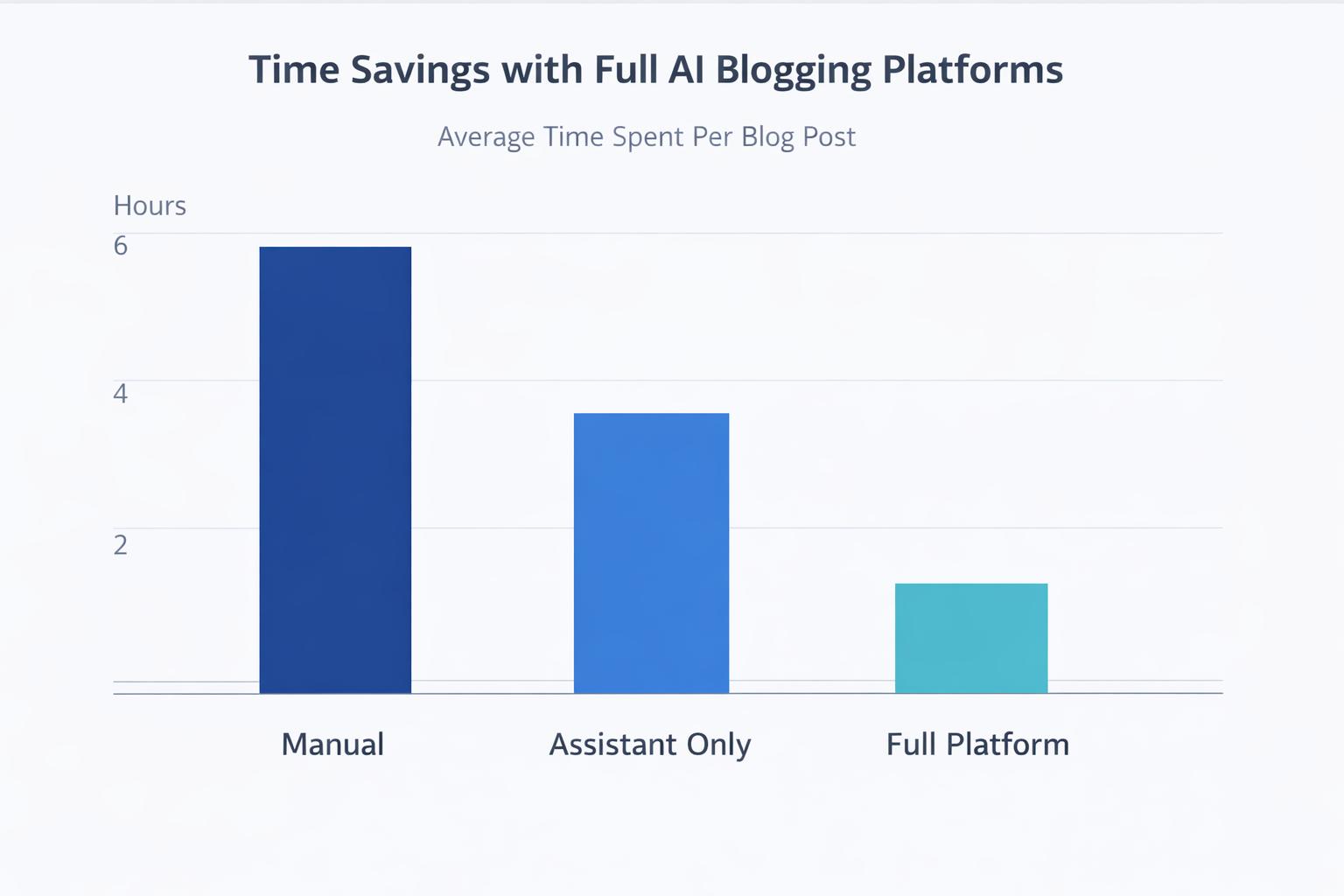
Industry benchmarks and case studies from content teams show that structured workflows can cut content production time by 30–70%. When you centralize keyword research, writing, SEO, and publishing in one platform, those gains become repeatable instead of one-off wins.
On paper, AI writing assistants look cheaper. Many start at $10–$30/month per user, while AI blogging platforms like Supablog start around $99/month.
But the real question is: what’s the cost per high-quality, SEO-ready article?
AI assistant: $20/month
SEO tool for keyword research: $100/month+
Stock images: $20–$50/month
Writer or editor time: 4–8 hours per post
Even if you ignore labor costs, your tool stack can easily match or exceed a single AI blogging platform subscription.
$99/month for up to 30 AI-generated and auto-published articles
Includes keyword research, SEO optimization, AI images, and analytics
Unlimited users per organization
When you divide cost by the number of SEO-ready posts, a platform often wins on cost per publishable article—especially once you pass 5–10 posts per month.
Sticking with a lightweight AI writing tool can be the right call in some situations.
You publish occasionally (e.g., one blog post every month or two).
Your blog is not yet a primary growth channel.
You mainly need help with emails, social posts, or internal docs.
You already have a strong SEO strategy and just want to speed up drafting.
Your team is very small and not ready to adopt a new platform.
In this phase, focus on mastering prompts, building a consistent tone, and learning what content resonates. You can always layer in a platform later once you start seeing traction.
An AI blogging platform becomes the better choice once content volume, SEO goals, or team complexity cross a certain threshold.
You want to grow organic traffic systematically, not just post occasionally.
You need to publish 10+ SEO-focused posts per month.
You manage content for multiple brands or websites (e.g., agencies).
You want data-driven decisions based on rankings, clicks, and conversions.
You’re tired of juggling multiple tools and manual handoffs.
At this stage, the question shifts from “How do we write faster?” to “How do we run content like a growth channel?” That’s exactly what AI blogging platforms are built for.
If you’re comparing AI blog platform features, here are the capabilities that matter most for long-term success.
Look for platforms that can automatically surface relevant keywords, group them into clusters, and suggest article ideas. This helps you build topical authority instead of chasing random topics.
Supablog, for example, includes automatic keyword research so you always have a prioritized list of topics to cover without living inside traditional SEO tools.
Not all AI-generated articles are equal. You want content that’s structured for search: clear headings, semantic coverage, internal link suggestions, and natural keyword use.
Resources like Google’s own guidelines on helpful content are a good reference point—your platform should help you align with these best practices rather than just stuffing keywords.
Strong blog posts rarely ship as walls of text. Check whether the platform supports:
AI image generation in multiple styles
Automatic or easy image placement throughout the article
Embedding relevant YouTube videos to boost engagement
Supablog can generate images and pull in relevant YouTube videos automatically, reducing the time you spend hunting for visuals.
Copy-pasting from docs into your CMS is one of the biggest hidden time sinks in content marketing. A strong AI blog platform should support:
Direct publishing to WordPress, Webflow, Shopify, Framer, and other CMSs
Consistent formatting and styling per site
Scheduled publishing and updates
Without feedback, your content strategy is guesswork. Look for:
Post-level performance metrics (traffic, rankings, CTR)
Trends across topics or clusters
Signals for which posts to refresh or expand
Pairing your platform with tools like Google Analytics and Google Search Console gives you a full picture of performance from impression to conversion.
Search rankings aren’t just about content quality; they’re also about authority. Some platforms, like Supablog, include automated backlink exchange to help you earn high-DR backlinks as you publish, strengthening your domain over time.
Supablog is firmly in the AI blogging platform category. It’s designed for marketers, agencies, and growth-focused teams who want to turn their blog into a predictable acquisition channel.
Generate up to 30 SEO-optimized articles per month with AI.
Run automatic keyword research and build a content pipeline.
Publish directly to WordPress, Webflow, Shopify, Framer, and more.
Add AI-generated images and relevant YouTube videos automatically.
Track performance analytics and refine your strategy over time.
Benefit from high DR backlinks via automated backlink exchange.
Support 150+ languages for global content strategies.
All of this comes with a 14-day free trial and a flat $99/month plan with unlimited users, making it easy for teams to adopt without per-seat complexity.
Use this quick checklist to decide between an AI writing assistant vs AI blogging platform.
We publish fewer than 4 blog posts per month.
SEO is nice-to-have, not a primary growth channel yet.
We mainly need help with short-form content (emails, social, sales collateral).
We don’t have a clear content strategy or keyword plan yet.
We want to grow organic traffic and leads from search.
We aim to publish at least 8–10 SEO-focused posts per month.
We’re tired of juggling multiple tools and manual steps.
We care about analytics and continuous improvement, not just publishing.
We manage content for multiple products, brands, or markets.
Choosing between an AI writing assistant vs AI blogging platform is ultimately about your ambition for content. If you just need to write faster, an assistant is perfect. If you want your blog to behave like a growth channel—with strategy, scale, and measurable ROI—a full AI blogging platform will pay off quickly.
If you’re ready to see what an end-to-end AI-powered workflow looks like, start a 14-day free trial of Supablog and ship your first batch of SEO-optimized posts in days, not months.
Written by
Pranjal JainFounder of Supablog, Pranjal is a software engineer passionate about building SaaS products that empower founders to grow and scale their businesses. With a strong focus on practical innovation, he creates tools that solve real-world challenges in the SaaS ecosystem. Outside of building and writing, he enjoys reading and traveling, drawing inspiration from new ideas, cultures, and experiences.