
The Future of SEO Content in the Age of Generative AI
Explore where search, content quality, and AI-generated articles are heading—and how to future-proof your blog strategy now.
The future of SEO content is not about who can publish the most AI-written articles. It is about who can combine generative AI, human judgment, and deep audience understanding to create content that search engines trust and users actually finish reading.
If you are a blogger, marketer, or SEO professional, you are likely asking yourself:
Will AI-generated content flood search and kill organic traffic?
How will Google and other engines treat AI vs human content?
What does a future-proof SEO content strategy look like now?
This opinion piece looks at the future of SEO content in the age of generative AI, what is changing under the hood of search, and how to adapt your blog strategy before you are left behind.
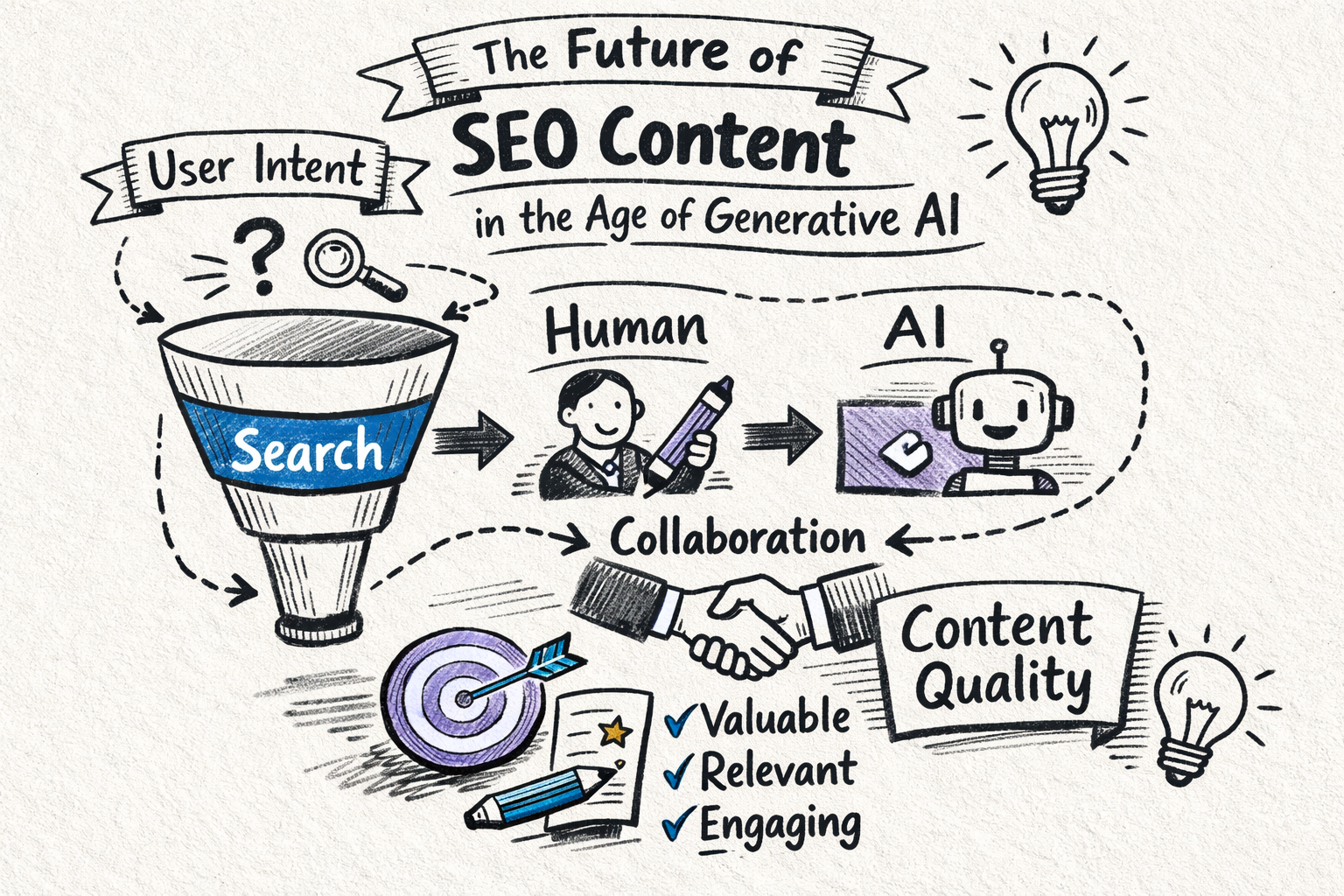
How generative AI is changing the SEO content game
Generative AI has already changed how content gets produced. The real shift is not that content is cheaper to create; it is that the volume of average content is exploding while search engines are under pressure to surface only the best.
From scarcity to overwhelming abundance
For a decade, SEO was constrained by production capacity. Teams asked, “How can we publish more?” Now, with AI blog writers and content generators, the constraint is reversed: attention and trust are scarce, not words.
That means:
Publishing more articles is no longer an edge.
Thin, generic how-to posts will increasingly be treated as noise.
Search engines will favor content with clear signals of expertise, originality, and usefulness.
Google’s guidance already reflects this. Their documentation on creating helpful, reliable, people-first content emphasizes experience, expertise, author transparency, and depth—not the tool you used to draft the text.
AI is a production engine, not a strategy
In my view, the biggest mistake marketers make with generative AI in content marketing is treating it as a strategy rather than a production layer. AI can help you:
Turn research and briefs into first drafts in minutes.
Localize or translate content into many languages.
Rewrite and refresh older posts at scale.
Generate variations for different audiences or platforms.
But AI will not tell you what truly matters to your audience, how your product is different, or what unique stance your brand should take. If you feed it generic inputs, you will get generic outputs—and that is precisely the type of content search engines are learning to ignore.
What search engines are really optimizing for in the AI era
To understand the future of SEO content, you have to look at what search engines are optimizing for, not just what they say in blog posts. The direction of travel is clear: less ranking by keyword matching, more ranking by user satisfaction and trust signals.
Helpful content, not just relevant content
Google’s Helpful Content Update and subsequent core updates are all pushing toward one idea: if users consistently do not find a page helpful, it will eventually lose visibility, regardless of how well it is optimized on-page.
In practice, this means the future of SEO content will be shaped by signals like:
Engagement and completion: Do users stay, scroll, and finish the article—or bounce quickly?
Next-step behavior: Do they click deeper into your site, sign up, or share the content?
Brand and author authority: Are you cited elsewhere? Is the author a credible expert?
Content freshness and maintenance: Is the piece updated as facts, products, and SERPs evolve?
Generative AI can help you ship content faster, but it cannot fake these signals at scale. Only genuinely useful, well-structured, and maintained content can.
Search is becoming an answer engine, not just a list of links
We are also seeing search engines shift from “10 blue links” to answer-oriented experiences:
AI Overviews and generative summaries at the top of results.
Featured snippets, People Also Ask, and entity-based knowledge panels.
Vertical experiences (shopping, local, video) tailored to intent.
As more answers appear directly in search, ranking is no longer the only goal. The question becomes: how do you create content that search engines want to summarize, cite, and send qualified traffic to?
That is where structured, well-researched, and highly specific content wins. When your article is the best explanation of a niche question, or the clearest breakdown of a complex process, it is more likely to be surfaced in these new formats.
AI and SEO trends that will shape the next 3–5 years
Looking ahead, several AI and SEO trends will shape how we plan and create content.
1. AI-assisted content will be the default, not the exception
Most serious publishers and brands will move to an AI-assisted workflow rather than fully manual or fully automated content.
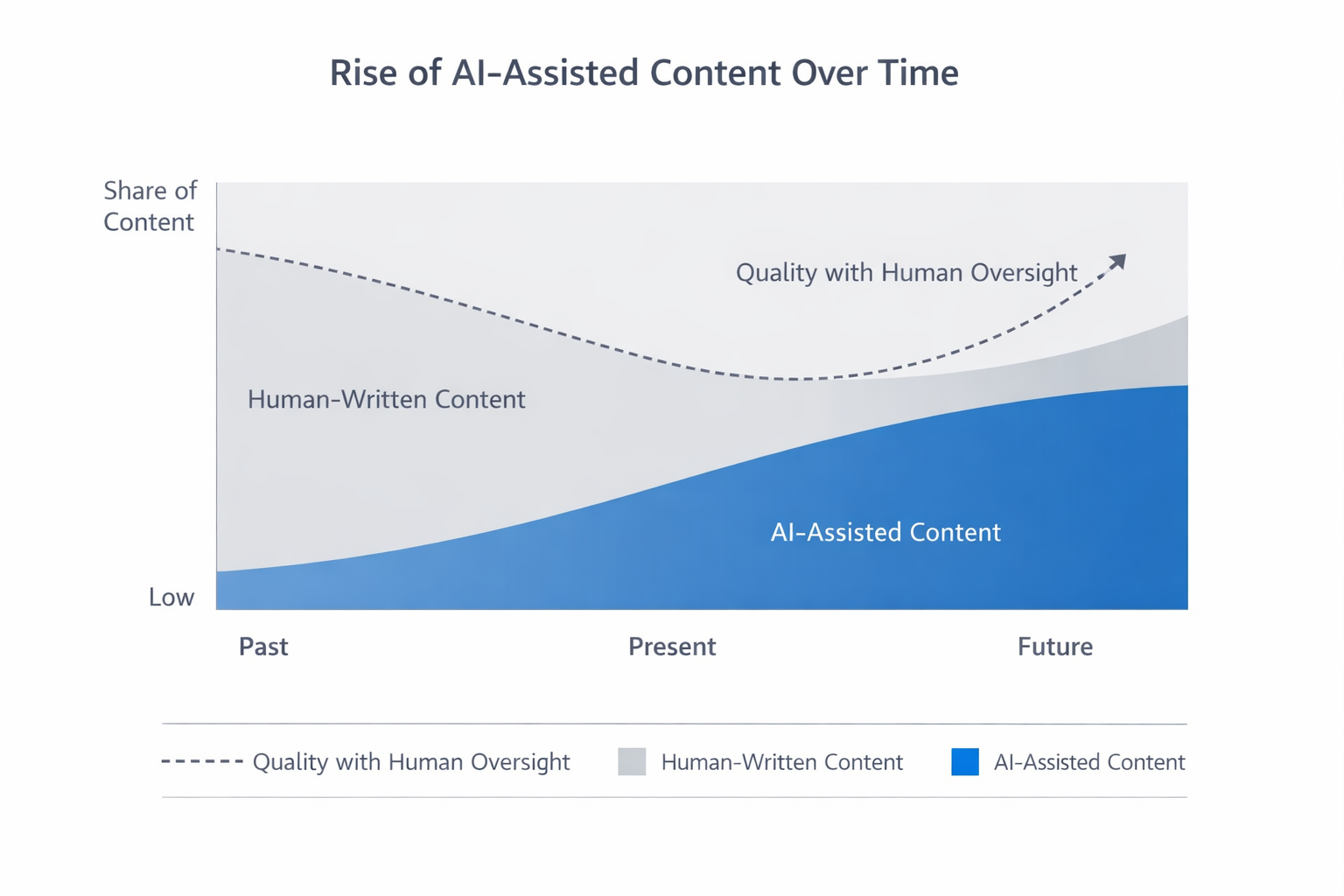
In that world, the differentiator is not whether you “use AI” but how intelligently you orchestrate it across:
Topic discovery and keyword research.
Outline and brief creation.
Drafting, revising, and editing.
On-page optimization and internal linking.
Updating and repurposing existing content.
Platforms like Supablog are built around this assumption: that content teams need an AI blogging platform to handle the repetitive SEO work so humans can focus on strategy, nuance, and real expertise.
2. E-E-A-T will become the real moat
As generative AI makes it trivial to produce “good enough” copy, Google’s E-E-A-T (Experience, Expertise, Authoritativeness, Trustworthiness) becomes the main filter for what surfaces consistently.
Expect to see more emphasis on:
Real authors with credentials attached to content.
First-hand experience (screenshots, data, case studies, personal stories).
Citations to reputable sources such as academic research or official documentation.
Clear editorial standards and update logs on important pages.
In other words, the future of SEO content is less about “sounding smart” and more about demonstrating that you have actually done the work.
3. Search engines will get better at detecting low-value AI content
Although Google has stated it is “rewarding high-quality content, however it is produced”, it is reasonable to assume they are investing heavily in detecting:
Patterned, template-driven AI content with minimal human editing.
Sites that publish at unnatural volumes without corresponding authority signals.
Content that paraphrases existing top results without adding value.
As models become more powerful, detection will not rely on “AI fingerprints” but on behavioral and quality signals: does this site behave like a thin affiliate farm or a real publisher?
4. Topic authority will matter more than individual keywords
Search engines are moving from keyword-level relevance to topic-level authority. That means:
Covering a subject in depth with multiple interlinked articles.
Maintaining and updating that content over time.
Demonstrating expertise through consistent, coherent coverage.
Generative AI makes it easier to build these topic clusters—but only if you have a clear strategy and editorial judgment. A tool like Supablog can automate keyword research, suggest related topics, and generate cluster content, while you decide what your brand should actually say on each topic.
What “high-quality content” will mean in the AI era
In the past, “high-quality content” often meant long-form, keyword-rich, and well-structured. Those are now table stakes. In the AI era, quality will be judged more by usefulness, differentiation, and credibility than by length.
1. Depth and specificity over generic breadth
AI is very good at producing broad, surface-level explanations. That means your edge is in going deeper and more specific than a model trained on the average of the internet.
Ask of every article:
What can we show (data, screenshots, workflows) that a generic model cannot?
What opinion or stance do we hold that is not obvious?
What niche angle or audience segment can we serve better than anyone?
2. Clear POV and editorial voice
AI tends to write in a neutral, inoffensive style. That is safe, but it is also forgettable. The future of SEO content belongs to brands with a recognizable voice and point of view.
This does not mean being contrarian for its own sake. It means:
Taking clear positions on how to do things (frameworks, playbooks, checklists).
Backing claims with evidence, examples, and transparent reasoning.
Writing in a way that feels like a real person, not a corporate press release.
3. Integrated formats: text, visuals, and video
Search is increasingly multimodal. Users expect not just text but visual explanations, short videos, and interactive elements. High-performing SEO content will feel more like a mini product or resource than a static article.
That might include:
Custom diagrams and concept visuals to explain complex ideas.
Embedded YouTube videos that demonstrate processes step-by-step.
Data visualizations that summarize key takeaways at a glance.
Supablog leans into this by supporting AI image generation for blogs and relevant YouTube video integration directly into articles, so your SEO content is richer without adding design overhead.
4. Continuous optimization, not one-and-done publishing
In a world where models are trained on the web and search results are constantly shifting, content cannot be static. High-quality content will be:
Monitored for performance (rankings, CTR, engagement, conversions).
Updated as new information, products, or competitors emerge.
Expanded or consolidated to maintain topical authority.
AI can help here too: tools like Supablog provide blog performance analytics and unlimited AI rewrites, making it feasible to maintain a large library of evergreen content without a huge editorial team.
A practical framework to future-proof your SEO content strategy
So how do you adapt to these trends without burning out your team? Here is a pragmatic framework I recommend for anyone serious about the future of SEO content.
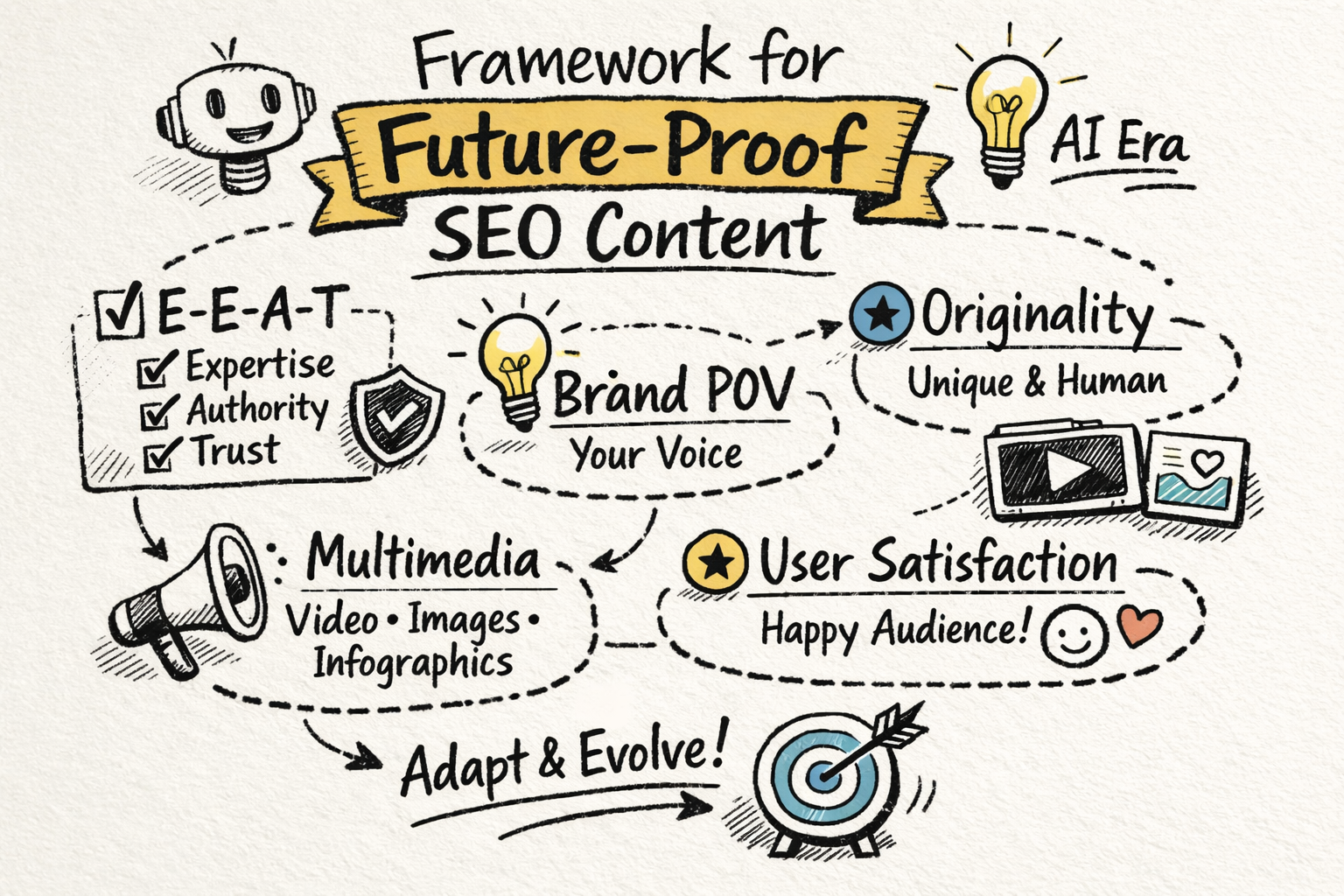
1. Start from problems, not keywords
Instead of starting with “what keyword can we rank for?”, start with “what problem is our audience trying to solve, and where are they getting stuck?” Then use keyword research to map those problems to search behavior.
In practice:
Interview customers and sales/support teams to gather real questions.
Use SEO tools to find how those questions show up in search (phrases, variants, intent).
Group them into topic clusters that you can own over time.
An AI SEO tool like Supablog can automate much of the keyword discovery and clustering, but the insight about which problems matter most has to come from you.
2. Design outlines that force originality
If you prompt an AI to “write a blog post about the future of SEO content,” you will get something that sounds plausible but generic. The trick is to design outlines and prompts that require unique input.
For example, build outlines that include sections like:
“Our experience: what we saw across X sites or Y campaigns.”
“Data from our product or customers.”
“Where we disagree with common advice and why.”
“A framework or checklist we actually use internally.”
Then use AI to draft around those anchors, not to invent them.
3. Build a human-in-the-loop editorial workflow
The safest and most effective way to use generative AI in SEO is a human-in-the-loop workflow where AI handles the heavy lifting and humans handle judgment.
A simple version of this workflow:
Define your topic, angle, and target reader.
Use AI to generate an outline and initial draft.
Have a subject-matter expert review, add real examples, and adjust the POV.
Use AI again to clean up structure, clarity, and on-page SEO (titles, meta, internal links).
Publish, measure performance, and schedule periodic refreshes.
Supablog is built around this kind of loop: it automates SEO-optimized blog posts from keyword to draft to publication, while giving your team full control over edits and approvals.
4. Invest in authority-building, not just content volume
In the next wave of AI and SEO trends, authority will be the constraint. Anyone can publish; not everyone can earn trust.
Alongside content creation, invest in:
Building high-quality backlinks from relevant, reputable sites.
Collaborating with recognized experts and featuring their insights.
Publishing original research, benchmarks, or case studies.
Supablog supports this by offering high DR backlinks via automated backlink exchange, helping your best content get the authority signals it deserves.
5. Treat your blog as a product, not a filing cabinet
The blogs that will win in the AI era are those that feel like living products: curated, maintained, and designed around user outcomes.
That means:
Regularly pruning or consolidating underperforming content.
Designing navigation and internal links around journeys, not just categories.
Using analytics to improve UX, not just rankings.
Think of each post as a feature in your “knowledge product.” If it no longer serves users or your strategy, refactor or retire it.
Where Supablog fits into the future of SEO content
Given all of this, what kind of tooling actually helps instead of just adding more noise? My view is that the winning stack will combine automation, insight, and control.
Supablog is built specifically for teams who want to embrace generative AI in content marketing without sacrificing quality or control. It brings together:
AI content generation for long-form, SEO-optimized blog posts.
Automatic keyword research and topic discovery so you are not guessing what to write.
On-page SEO optimization baked into the writing process.
AI image generation and YouTube integration for richer posts.
Multi-platform publishing to WordPress, Webflow, Shopify, Framer, and more.
Performance analytics to inform updates and future topics.
Crucially, it is designed for teams and agencies that need to scale content without scaling headcount: unlimited users per organization, automated workflows, and a predictable monthly price.
My opinion: AI will not kill SEO, but it will kill lazy SEO
Here is the honest take: AI is not the end of SEO. It is the end of low-effort, copycat SEO that relied on out-publishing competitors with similar content.
In the next few years, I expect to see:
Many sites that leaned on bulk AI content lose traffic as quality filters tighten.
Brands that combine AI efficiency with strong editorial POV grow faster than ever.
SEO teams evolve into content strategists and editors, not just keyword operators.
If you are willing to invest in real expertise, thoughtful strategy, and human oversight, generative AI becomes a massive advantage—not a threat.
Key takeaways and next steps
To recap, the future of SEO content in the age of generative AI will reward those who:
Use AI as a production engine, not a substitute for strategy.
Optimize for user satisfaction and E-E-A-T, not just keywords.
Focus on depth, specificity, and clear POV over generic volume.
Adopt human-in-the-loop workflows and continuous optimization.
Treat their blog as a living product that earns trust over time.
If you want to experiment with this kind of workflow in practice, try setting up a pilot process where you:
Pick one topic cluster that matters to your business.
Use an AI-powered content platform like Supablog to handle research, drafting, and optimization.
Have your team focus on injecting real expertise, examples, and POV.
Measure performance over 3–6 months and refine your playbook.
The future of SEO content will belong to those who can blend AI scale with human insight. If you build that muscle now, the next wave of search changes will be an opportunity, not a risk.
Written By
Pranjal Jain
Founder of Supablog, Pranjal is a software engineer passionate about building SaaS products that empower founders to grow and scale their businesses. With a strong focus on practical innovation, he creates tools that solve real-world challenges in the SaaS ecosystem. Outside of building and writing, he enjoys reading and traveling, drawing inspiration from new ideas, cultures, and experiences.
View other articles by this author