Multilingual SEO Content: How to Use AI to Go Global Without Losing Quality
Plan, create, and localize multilingual blog content with AI while preserving search intent and brand voice.

Plan, create, and localize multilingual blog content with AI while preserving search intent and brand voice.
Pranjal Jain
Ranking globally is no longer about translating a few pages and hoping for the best. If you want to win in new markets, your multilingual SEO content needs to match local search intent, feel native to readers, and still sound like your brand.
AI makes this possible at scale—but only if you use it strategically. Done wrong, AI translation turns your blog into a patchwork of awkward phrases, keyword mismatches, and SEO cannibalization. Done right, it becomes the engine of a sustainable global content strategy.
In this guide, you will learn how to plan, create, and localize multilingual blog content with AI while preserving search intent, brand voice, and quality. We will walk through workflows, tools, quality checks, and practical examples so you can go global without losing what makes your content work today.
Multilingual SEO content is any search-optimized content (usually blogs, guides, and landing pages) that you create in multiple languages to rank in different countries or regions.
It is not just your English blog translated into Spanish, German, or Japanese. Effective multilingual SEO content is:
Language-specific: Written in the target language with natural phrasing and idioms.
Market-specific: Reflects local search behavior, competitors, and regulations.
Intent-aligned: Matches what users in that market are actually trying to achieve.
Technically optimized: Uses proper hreflang, URL structures, and on-page SEO for each version.
Google and other search engines evaluate each language version as its own page. If you simply translate keywords and headings word-for-word, you often miss how people really search in that language—and you leave rankings on the table.
Until recently, a serious multilingual content strategy required big budgets, multiple agencies, and long lead times. AI has changed the economics completely.
With the right setup, you can now:
Generate content in 150+ languages from a single strategy and brief.
Localize at scale without hiring a full in-house team of native writers for every market.
Iterate quickly: test topics, formats, and angles in new markets before committing large budgets.
Maintain consistency: keep your brand voice and structure aligned across all languages.
Platforms like Supablog combine AI blog writing, SEO optimization, and multilingual generation so you can plan and publish globally from one place instead of stitching together separate tools.
However, AI alone is not a silver bullet. Common failure modes include:
Literal translations of keywords that no one actually searches for in that market.
Broken brand voice where tone becomes robotic or inconsistent across languages.
Cultural misses—references, examples, or metaphors that don’t land or are inappropriate.
Duplicate or thin content that search engines see as low value, hurting your international SEO content performance.
The rest of this guide focuses on how to use AI translation for blogs and full content creation without falling into these traps.
Most multilingual SEO failures start with a missing strategy. Before you ask AI to write in another language, clarify three things: markets, topics, and goals.
Start small and focused. It is better to dominate two markets than to be invisible in ten.
Look at current demand: where are you already getting traffic, signups, or customers from?
Assess competition: in some languages, your niche might be underserved, giving you an easier path to rank.
Align with revenue: prioritize languages tied to existing or planned sales motions.
For many SaaS and content-driven businesses, a typical rollout order might be: English → Spanish → German → French → Portuguese → Japanese.
Once you know your markets, you need to understand what people in each language actually search for. Do keyword research per language—never just translate your English keywords.
Use tools like Google Keyword Planner or language filters in SEO tools to identify:
Core transactional terms (e.g., “software de facturación online” vs. “online invoicing software”).
Informational topics for top-of-funnel content (guides, how-tos, comparisons).
Regional variations (e.g., European vs. Latin American Spanish, Brazilian vs. European Portuguese).
Then design a topic cluster per language: a set of pillar pages and supporting blog posts that cover a theme in depth. This makes it easier for search engines to understand your authority in each market.
What does success look like for your multilingual content strategy?
Traffic goals: organic sessions from each language subfolder or subdomain.
Engagement: time on page, scroll depth, bounce rate.
Conversions: email signups, trials, demos, or other CTAs localized per market.
Set realistic timelines—new language sections often need 3–6 months to show strong organic traction, depending on your domain authority and publishing volume.
Not every piece of content should follow the same path. For each article or topic, decide whether to:
Translate (keep structure and examples, adapt wording).
Localize (adapt structure, keywords, examples, CTAs to the market).
Create net-new content (when the market has unique needs or search patterns).
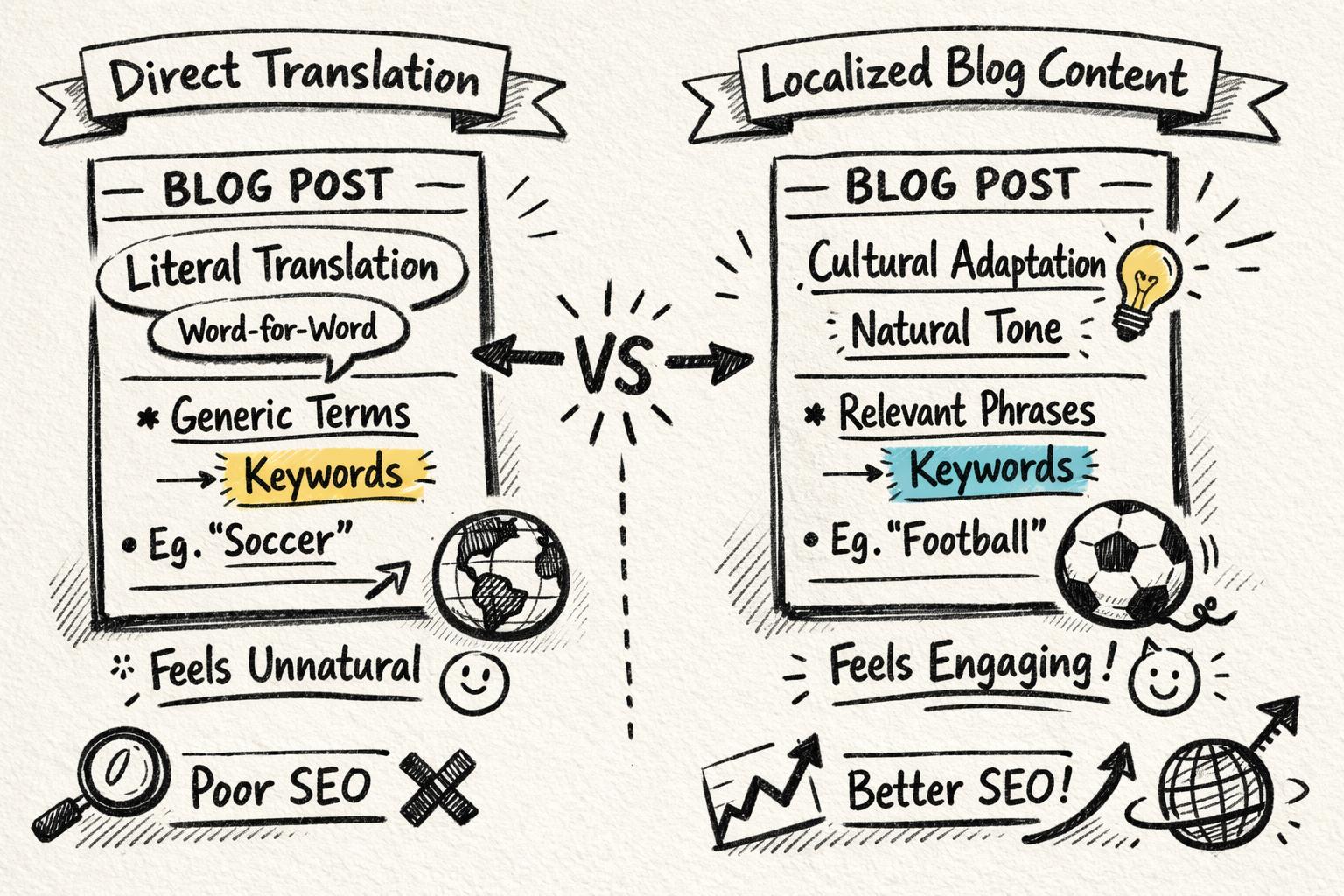
Use AI translation for blogs with light human review when:
The topic is universal (e.g., “what is two-factor authentication”).
Search intent is nearly identical across markets.
The article is mostly educational, with few local references.
Here, your main job is to ensure linguistic accuracy and keyword alignment in headings and key sections.
Choose localization over direct translation when:
Examples, case studies, or pricing are tied to a specific country.
Regulations differ (e.g., data privacy, employment law, tax rules).
Search behavior diverges (e.g., different terms for the same concept).
In these cases, you want AI to reframe your content for the target audience, not just translate it. This is where a platform like Supablog, with localization-aware AI workflows, is more effective than a generic machine translation API.
Sometimes, the best-performing content in a new language has no direct equivalent in your original content library. For example:
A Spanish audience might search more for “plantillas” (templates) and “ejemplos” (examples) than English readers.
German users might prefer in-depth, technical breakdowns versus short overviews.
Japanese readers might respond better to highly structured, step-by-step guides.
Here, use AI to generate content from scratch in the target language, based on local keyword research and briefs—not as a translation of an English post.
Even the best multilingual content will underperform if your technical setup is confusing to search engines.
For most blogs and SaaS companies, the safest and most scalable option is:
Subfolders per language: example.com/es/blog/..., example.com/de/blog/...
Subfolders consolidate domain authority while clearly signaling language. Alternatives include subdomains (es.example.com) or country domains (example.de), but they require more SEO effort and maintenance.
hreflang tags tell search engines which language and region each page targets and how different versions relate to each other. Correct implementation reduces duplicate content issues and ensures users see the right language version.
Follow Google’s guidelines on localized versions and hreflang to:
Specify the language (e.g., es, de, fr).
Optionally specify region (e.g., es-MX, pt-BR).
Ensure each language version references all others (reciprocal linking).
For every language version, don’t forget to localize:
Title tags and meta descriptions.
H1–H3 headings with localized primary and secondary keywords.
Slugs (URLs) so they include the main keyword in that language.
Alt text for images, especially when they support SEO-relevant sections.
An AI SEO tool like Supablog can automate much of this by generating SEO-optimized titles, meta descriptions, and slugs per language, based on your target keywords.
The key to preserving search intent and brand voice across languages is to start with a strong master brief in your primary language.
For each article you want in multiple languages, define:
Primary keyword and related secondary keywords.
Target persona and stage of the funnel.
Search intent (informational, commercial, transactional).
Key points, structure, and must-include sections.
Brand voice guidelines (tone, formality, phrases to use/avoid).
In Supablog, you can encode much of this into reusable templates, so every AI-generated or localized article starts from the same strategic foundation.
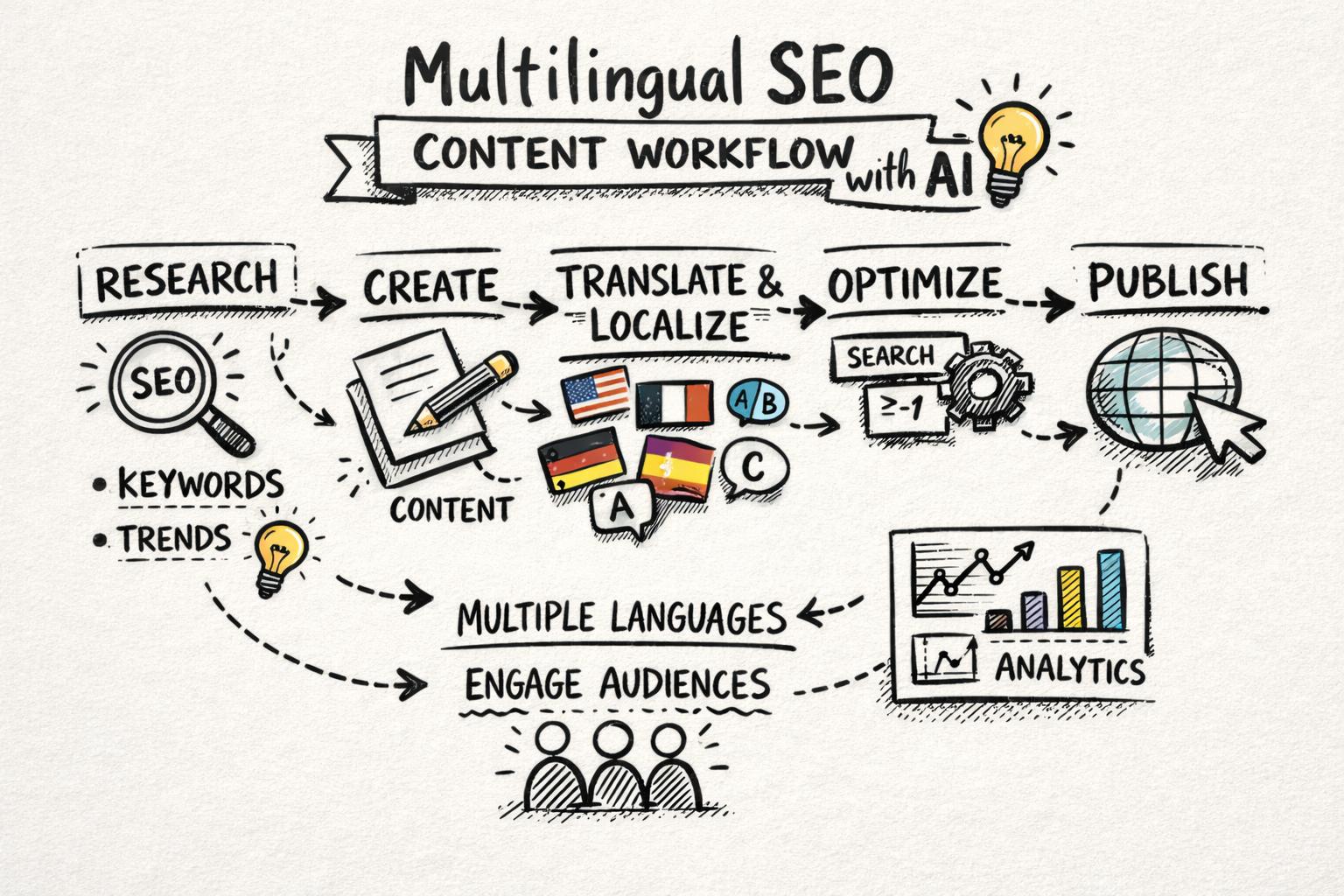
Create the original article in your primary language using your AI blogging platform or internal team.
Validate performance (does it rank, convert, and resonate?).
Generate localized versions with AI, using language-specific keyword inputs.
Review and refine with native speakers or in-market marketers when possible.
Publish and monitor performance per language section.
This is where an AI content creation tool built for SEO, like Supablog, provides leverage: you can manage keyword research, content generation, and publishing across 150+ languages from a single dashboard.
There are two main ways to use AI for multilingual content:
AI translation: translate existing articles into other languages.
AI-native writing: generate content directly in the target language.
Both have a place in a mature global content marketing strategy.
Pros:
Fast way to expand your content library into new languages.
Ensures structural and topical consistency with the original article.
Cheaper than human-only translation or net-new writing.
Cons:
Risk of unnatural phrasing or missed cultural nuances.
Keywords may not match how locals search.
Can propagate issues from the original article (if the brief wasn’t strong).
Pros:
Content can be shaped around local keyword research from the start.
More flexibility in tone, examples, and structure per market.
Better fit for markets with very different search behavior.
Cons:
Requires a stronger multilingual content operations setup.
Harder to keep all languages perfectly aligned without a good master strategy.
Still benefits from human review for high-stakes pages.
The most effective teams often mix both approaches: translate and lightly localize proven evergreen content, while create net-new AI-native content around local trends and opportunities.
One of the biggest fears with multilingual SEO content is losing your brand voice. AI can help here—if you teach it what your voice sounds like.
Instead of vague statements like “sound friendly but professional,” create concrete, AI-ready guidelines. For example:
Formality: informal “you” vs. formal “you” (important in languages like German, Spanish, French).
Sentence length: short, punchy sentences vs. longer, more complex ones.
Jargon level: plain language vs. expert terminology.
Signature phrases: words you often use (and those you avoid).
Feed these into your AI blogging platform as reusable instructions. Supablog, for example, lets you standardize tone and style so every article—no matter the language—feels like it comes from the same brand.
Brand voice isn’t copied 1:1 between languages. A “friendly and direct” English tone might feel too aggressive in Japanese or too vague in German.
Work with native speakers or local marketers to adjust:
How direct you are in CTAs.
How much humor or informality you use.
How you reference authority, data, or social proof.
Then encode those differences into your AI prompts per language, so your localization with AI respects cultural expectations while staying on-brand.
To protect your brand and SEO performance, build a lightweight but consistent QA process for every language.
Whenever possible, have a native speaker review key pages:
Homepage and core landing pages.
High-traffic blog posts.
Content close to conversion (pricing, product comparisons, case studies).
They should check for:
Awkward or incorrect phrasing.
References that don’t make sense locally.
Potentially sensitive or misinterpreted wording.
Before publishing, confirm that each language version:
Targets the right localized primary keyword.
Uses that keyword in title, H1, slug, and key headings naturally.
Includes internal links to relevant pages in the same language section.
Has localized meta descriptions and image alt text.
AI SEO tools and content analytics can automate many of these checks, flagging pages where on-page optimization is weak.
After publishing, track performance per language:
Organic traffic and impressions (via Google Search Console language/country filters).
Average position for target keywords.
Engagement metrics (bounce rate, time on page, scroll depth).
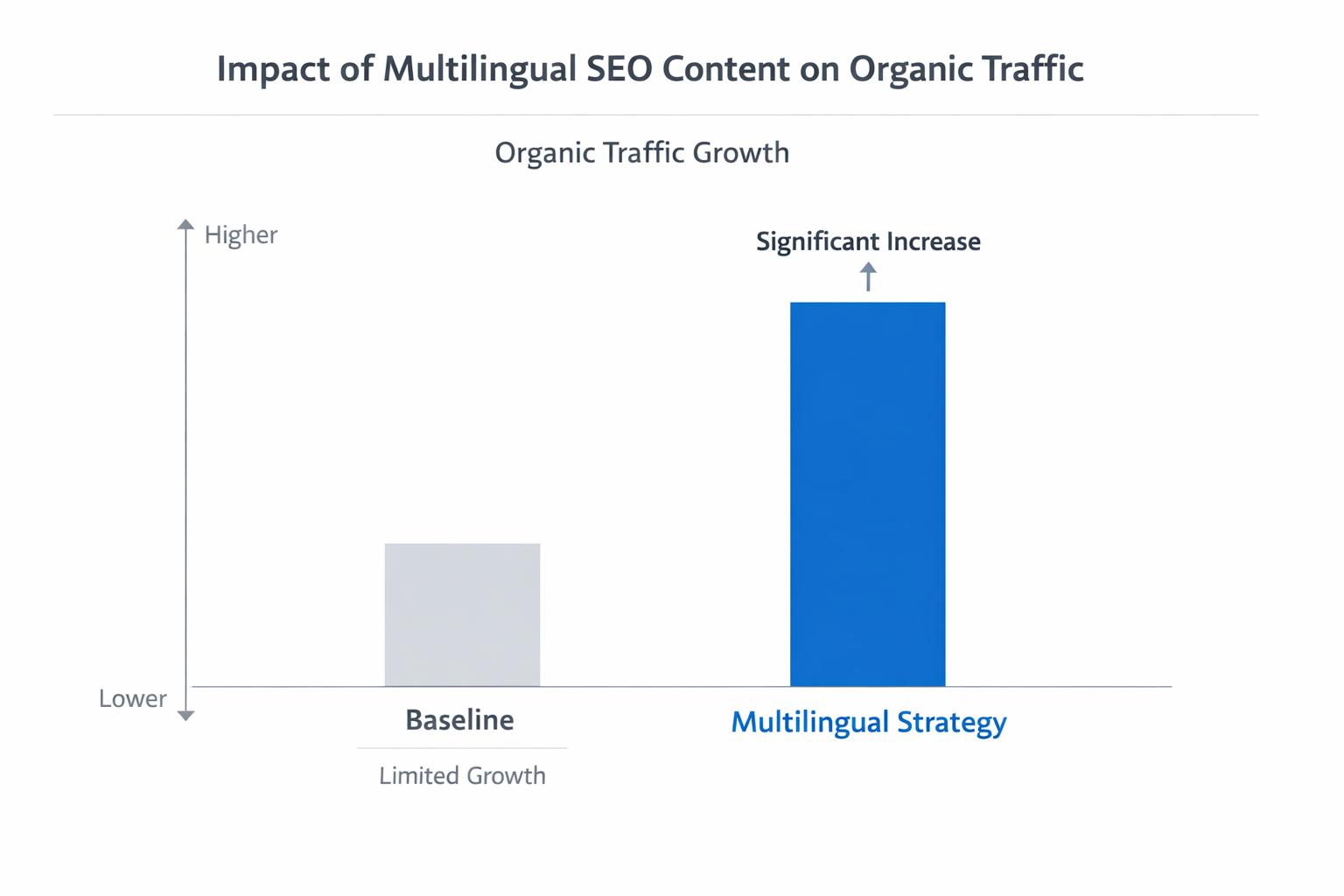
Use this data to decide which topics to double down on in each market and where to refresh or expand content. According to multiple industry studies, including localization research from CSA, users are far more likely to buy from and trust brands that speak their language—so improvements here often have a direct revenue impact.
To sustain a multilingual content program, you need more than good ideas—you need a repeatable workflow.
Multilingual generation: support for 50+ languages at a minimum; 100+ if you plan to scale aggressively.
SEO optimization: keyword suggestions, on-page checks, and SERP-aware drafting.
Content templates for briefs, outlines, and brand voice.
Multi-platform publishing to CMSs like WordPress, Webflow, Shopify, and others.
Analytics and reporting by language, topic, and funnel stage.
Supablog was built specifically for this kind of scalable, SEO-first content operation. It combines:
Automatic keyword research so you can discover opportunities in each language without manual digging.
AI-generated, SEO-optimized blog posts in 150+ languages, with unlimited rewrites.
AI image generation and YouTube integration to keep your articles engaging.
One-click publishing to multiple platforms and built-in performance analytics.
This kind of integrated workflow lets lean teams execute a global content marketing strategy that used to require a full international content department.
Copy-pasting content into a generic translator and publishing the result is a fast way to damage your brand and rankings. At minimum, run AI-translated content through:
A localized keyword check.
A quick native speaker review for key pages.
An on-page SEO audit.
Avoid combining multiple languages on a single URL (e.g., English and Spanish in one article). It confuses users and search engines and makes hreflang nearly impossible to manage.
Search results can look very different by country. Before finalizing your content, check the local SERP for your target keyword (e.g., via VPN or location settings) and note:
What types of content rank (guides, videos, tools, product pages).
The average depth and format (long-form vs. short, list posts vs. tutorials).
Local competitors you may not know from your home market.
Then adapt your content format, structure, and depth to match or exceed what’s already working there.
Language variants matter. Spanish for Mexico, Spain, and Argentina differ in vocabulary, tone, and sometimes even product expectations. The same goes for Brazilian vs. European Portuguese, or US vs. UK English.
Where it matters for your business, create separate language-region variants (e.g., es-mx and es-es) and adjust wording accordingly, following Google’s international targeting best practices.
Here is how a lean marketing team might roll out a multilingual SEO content program over 90 days using AI:
Weeks 1–2: Strategy and setup
Choose 1–2 priority languages beyond your primary one.
Do keyword research per language and define topic clusters.
Set up URL structure, hreflang, and analytics segmentation.
Configure your AI blogging platform (brand voice, templates, workflows).
Weeks 3–6: Content creation and localization
Identify 10–20 of your best-performing English posts.
Use AI to translate and localize them into your target languages.
Create 5–10 net-new articles per language based on local keyword gaps.
Run QA on high-value pages and publish in batches.
Weeks 7–12: Optimization and scale
Monitor rankings, traffic, and engagement by language.
Refresh underperforming content with updated keywords and AI rewrites.
Expand into adjacent topics and add internal links across your clusters.
Plan your next wave of languages based on early results.
Going global used to mean choosing between quality and scale. With modern AI and a solid multilingual content strategy, you can have both—if you respect local search intent, invest in the right workflows, and keep humans in the loop where it matters most.
Supablog is designed to make that possible for lean teams. With AI-generated, SEO-optimized blog posts in 150+ languages, automatic keyword research, and integrated publishing and analytics, it gives you the infrastructure to execute a serious international SEO content strategy without building a large in-house team.
If you are ready to turn multilingual SEO content into a growth channel instead of a side project, start by defining your priority markets, mapping local search intent, and choosing an AI blogging platform that can support you end-to-end.
From there, the path to global traffic and revenue is a matter of consistent execution—not guesswork or manual translation.
Written by
Pranjal JainFounder of Supablog, Pranjal is a software engineer passionate about building SaaS products that empower founders to grow and scale their businesses. With a strong focus on practical innovation, he creates tools that solve real-world challenges in the SaaS ecosystem. Outside of building and writing, he enjoys reading and traveling, drawing inspiration from new ideas, cultures, and experiences.