SEO Content Brief Template for AI Writers
Use this SEO brief template to give AI the right instructions so your articles rank and read like they’re written by experts.

Use this SEO brief template to give AI the right instructions so your articles rank and read like they’re written by experts.
Pranjal Jain
If your AI articles are missing the mark on search intent, structure, or depth, the problem usually isn’t the model—it’s the brief.
This SEO content brief template for AI writers gives you a repeatable way to tell any AI exactly what to write so posts rank, satisfy readers, and sound like real experts wrote them.
Use this as a plug-and-play framework, or build it into an automated workflow with an AI blogging platform like Supablog. For a full strategy view of how AI fits into your content engine, see our complete guide to AI content marketing for organic growth.
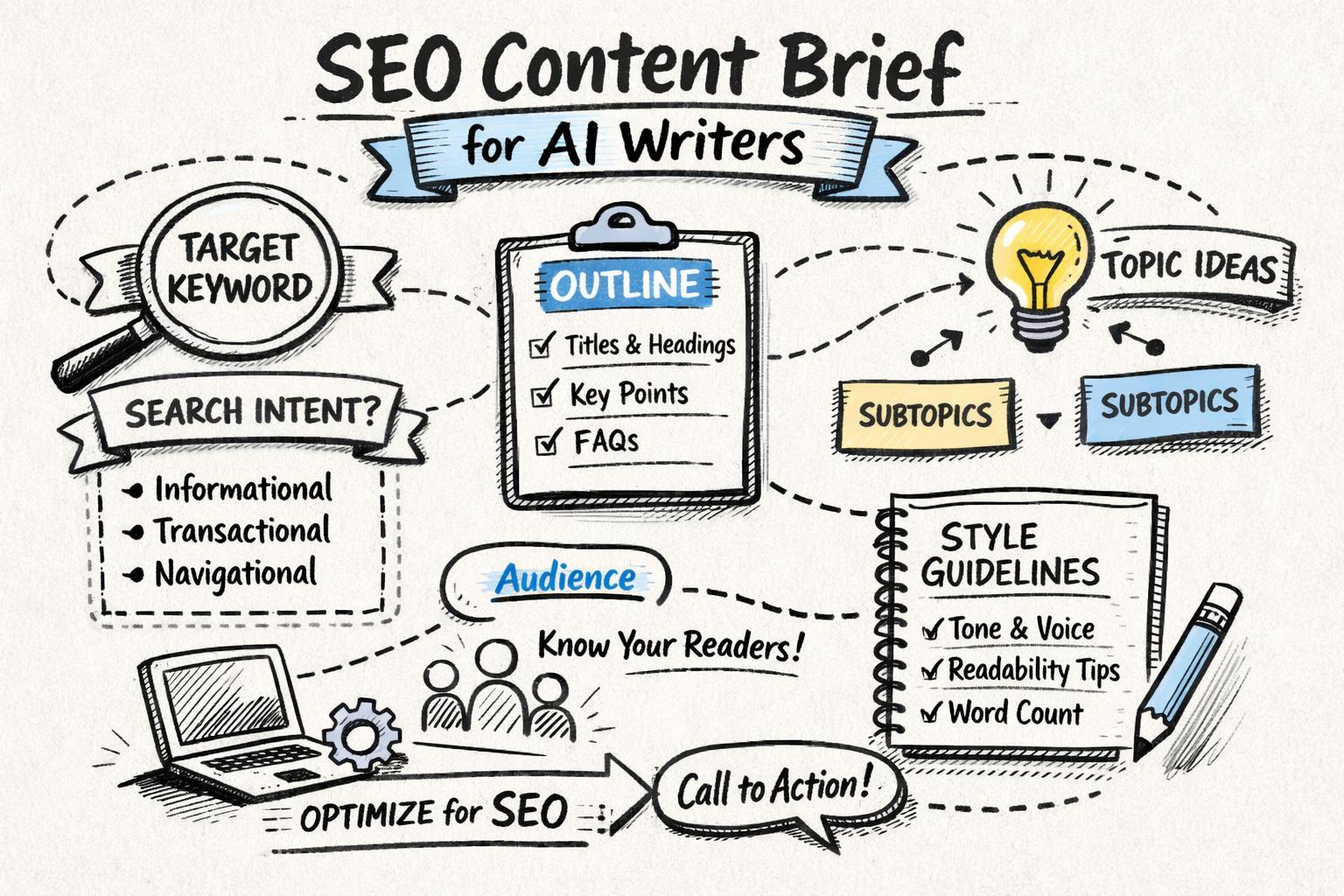
This template is designed for:
Marketers and SEOs who want AI to draft first versions of blog posts
Agencies creating a content brief for AI writers and junior writers at the same time
Teams that want consistent, on-brand, SEO-optimized content without hand-holding every draft
It’s especially useful when you’re:
Targeting competitive keywords where structure and depth matter
Producing many posts at scale and need standardization
Building a content workflow automation from keyword to published article (see our guide on content workflow automation with AI tools)
Below is the complete SEO content brief template, followed by a filled-in example and implementation tips.
Use this as your master blog post brief template. Replace the brackets with your own inputs.
Title: [Proposed SEO title]
Subtitle: [Optional supporting subtitle]
Content Type: [Blog post / Guide / Tutorial / Comparison / Listicle / Case study]
Primary Goal: [Rank for X / Generate leads / Product education / Thought leadership]Primary Keyword: [Exact primary keyword]
Secondary Keywords: [List 5–15 related keywords and phrases]
Search Intent: [Informational / Commercial / Transactional / Navigational]
Target SERP Features: [Featured snippet / People Also Ask / FAQ schema / How-to schema]
Target Word Count Range: [e.g., 1,800–2,200 words]To choose the right keywords and intent, you can reference resources like Google’s SEO starter guide or your own keyword tools.
Primary Audience: [Who this is for, e.g., “B2B SaaS marketing managers at Series A–C startups”]
Experience Level: [Beginner / Intermediate / Advanced]
Pain Points:
- [Pain point 1]
- [Pain point 2]
- [Pain point 3]
Desired Outcome for Reader: [What success looks like after reading]Brand: [Your company name]
Tone of Voice: [e.g., Professional, direct, slightly witty, no fluff]
Writing Style Notes:
- [Sentence length, jargon rules, point of view, etc.]
Words / Phrases to Use: [List any brand terms or product names]
Words / Phrases to Avoid: [Jargon, clichés, competitor names, etc.]Core Thesis: [1–2 sentences explaining the main argument or promise]
Unique Angle: [What makes this article different from top 3 ranking pages]
Key Takeaway: [What the reader should remember if they forget everything else]This is where you turn your keyword and intent research into a clear SEO article outline.
H1: [Main headline]

H2: [Section 1 heading]
- [Bullet point 1: what to cover]
- [Bullet point 2]

H2: [Section 2 heading]
- [Bullet point 1]
- [Bullet point 2]

H2: [Section 3 heading]
- [Bullet point 1]
- [Bullet point 2]

H2: [Conclusion heading]
- [Summarize key points]
- [Optional CTA or next step]
For more help turning outlines into rankable drafts, see our AI SEO content optimization tutorial.
Target URL Slug: [/your-target-url]
Meta Title: [70 characters max, include primary keyword near the start]
Meta Description: [140–160 characters, compelling and benefit-driven]
H1: [Usually similar to meta title, but can be longer]
Internal Links to Include:
- [URL] – [Anchor text]
- [URL] – [Anchor text]
External References to Consider:
- [Authoritative source 1]
- [Authoritative source 2]
Make sure your on-page SEO brief reflects best practices such as descriptive title tags and logical internal linking, as outlined in resources like Moz’s on-page SEO guide.
Must-Include Subtopics:
- [Subtopic 1]
- [Subtopic 2]
- [Subtopic 3]

Stats / Data Points to Include (if available):
- [Data source + key number]
- [Data source + key number]

Examples / Use Cases:
- [Example 1]
- [Example 2]

Expert POV:
- [Any non-obvious insights, trade-offs, or opinions to emphasize]Formatting Requirements:
- Use H2s and H3s to break up sections
- Use bullet lists for steps, pros/cons, and checklists
- Keep paragraphs short (2–4 sentences)
- Include at least [X] examples
- Include a clear conclusion with next steps
Readability Constraints:
- Aim for [e.g., Grade 8–10] reading level
- Avoid long, complex sentences
- Explain any necessary jargon in plain languagePrimary CTA: [What we want readers to do next, e.g., “Start a 14-day free trial”]
Secondary CTA: [Newsletter signup / Download template / Book demo]
Relevant Product Features to Mention:
- [Feature 1]
- [Feature 2]
- [Feature 3]
Placement Notes:
- [Where to naturally introduce the product without being pushy]Instructions for the AI:
- Follow the outline strictly unless changes are needed for clarity
- Prioritize accuracy and practicality over creativity
- Do not invent statistics; only use data when a credible source is given
- Do not mention being an AI model
- Use the brand voice guidelines above
- If you are unsure about a fact, acknowledge uncertainty instead of fabricatingHere is the same SEO content brief template filled in for this exact article, so you can see how everything connects.
Title: SEO Content Brief Template for AI Writers
Subtitle: Use this SEO brief template to give AI the right instructions so your articles rank and read like they’re written by experts.
Content Type: Blog post / Template
Primary Goal: Capture and convert mid-funnel readers researching content briefs into Supablog users.Primary Keyword: seo content brief template
Secondary Keywords: ai writing brief, blog post brief template, seo article outline, content brief for ai writers, on-page seo brief, seo content outline template
Search Intent: Informational (with light commercial intent)
Target SERP Features: Featured snippet + People Also Ask
Target Word Count Range: 2,000–2,500 wordsPrimary Audience: Content marketers, SEOs, and agencies using or evaluating AI for blog content.
Experience Level: Intermediate. They understand SEO basics and tools but want better systems and templates.
Pain Points:
- AI drafts that miss search intent or keyword coverage
- Inconsistent quality across AI-generated posts
- Time wasted rewriting vague AI outputs
Desired Outcome for Reader: A plug-and-play SEO brief template they can use immediately and integrate into their AI workflows.Brand: Supablog
Tone of Voice: Professional, direct, slightly promotional, no fluff, focused on results and practical steps.
Writing Style Notes:
- Short paragraphs, clear headings, plenty of lists
- Avoid hype; be realistic about AI’s strengths and limits
- Use concrete examples instead of vague claims
Words / Phrases to Use: AI blogging platform, SEO-optimized blog posts, content workflow automation, AI blog writer.
Words / Phrases to Avoid: “Magic,” “push-button success,” or unrealistic promises.Core Thesis: The quality of your AI content is determined more by the brief than the model. A structured SEO content brief template dramatically improves rankings, readability, and conversion.
Unique Angle: Shows a complete, copyable template plus a filled-in real example, and explains how to plug it into an AI-native blogging platform workflow.
Key Takeaway: If you standardize your briefs, you can safely scale AI-written content without sacrificing quality.H1: SEO Content Brief Template for AI Writers
H2: What this SEO content brief template is for (and when to use it)
- Clarify who should use it and in what scenarios
H2: Copy-and-paste SEO content brief template for AI writers
- Present the full template, section by section
H2: Filled-in example: SEO content brief template for AI writers
- Show the template completed for this article
H2: How to use this template with AI tools (and avoid common pitfalls)
- Turn the brief into prompts
- Common mistakes and how to fix them
- Where Supablog fits into the workflow
H2: Final checklist before you generate and publish
- Short checklist referencing our AI blog post checklist resourceTarget URL Slug: /blog/seo-content-brief-template-for-ai-writers
Meta Title: SEO Content Brief Template for AI Writers (Free Copy-Paste Outline)
Meta Description: Use this SEO content brief template to give AI clear instructions so your blog posts rank, satisfy search intent, and sound like they’re written by experts.
H1: SEO Content Brief Template for AI Writers
Internal Links to Include:
- /blog/the-complete-guide-to-ai-content-marketing-for-organic-growth – complete guide to AI content marketing
- /blog/ai-seo-content-optimization-tutorial – AI SEO content optimization tutorial
- /blog/content-workflow-automation-with-ai-tools – content workflow automation with AI tools
- /blog/ai-blog-post-checklist-before-you-publish – AI blog post checklist
- /blog/ai-blog-content-calendar-template – AI blog content calendar template
External References to Consider:
- Google Search Central: SEO starter guide
- Moz: On-page SEO factorsMust-Include Subtopics:
- Why briefs matter more with AI than with human writers
- How to translate SEO research into a structured brief
- Example of a filled-in brief
- How to integrate the brief into an automated workflow
Stats / Data Points to Include:
- Any credible stats on AI content usage or content production volume (if available)
Examples / Use Cases:
- In-house marketing team scaling from 4 to 20 posts/month
- Agency delivering consistent AI-assisted drafts across clients
Expert POV:
- Be honest about the need for human review and editing
- Emphasize that briefs are living documents that evolve with SERPs and performance dataFormatting Requirements:
- Use H2s and H3s for each section of the template
- Use code blocks for the template itself to make copying easy
- Use bullet lists for examples and use cases
- Include 1–2 diagrams or visuals to show the workflow
Readability Constraints:
- Aim for a clear, concise style suitable for busy professionals
- Avoid overly technical jargon unless explainedPrimary CTA: Encourage readers to try Supablog’s 14-day free trial to automate keyword research, brief creation, AI drafting, and publishing.
Secondary CTA: Encourage readers to bookmark or save the template and share with their team.
Relevant Product Features to Mention:
- AI content generation for blog posts
- Automatic keyword research and SEO optimization
- Content workflow automation and multi-platform publishing
Placement Notes:
- Introduce Supablog early as an example of an AI blogging platform
- Reiterate benefits in the “how to use this template with AI tools” section
- Close with a clear CTA in the conclusion.Instructions for the AI:
- Follow the template structure exactly
- Explain each section clearly but avoid unnecessary repetition
- Use Supablog as the product example where relevant
- Include internal and external links where they genuinely support the content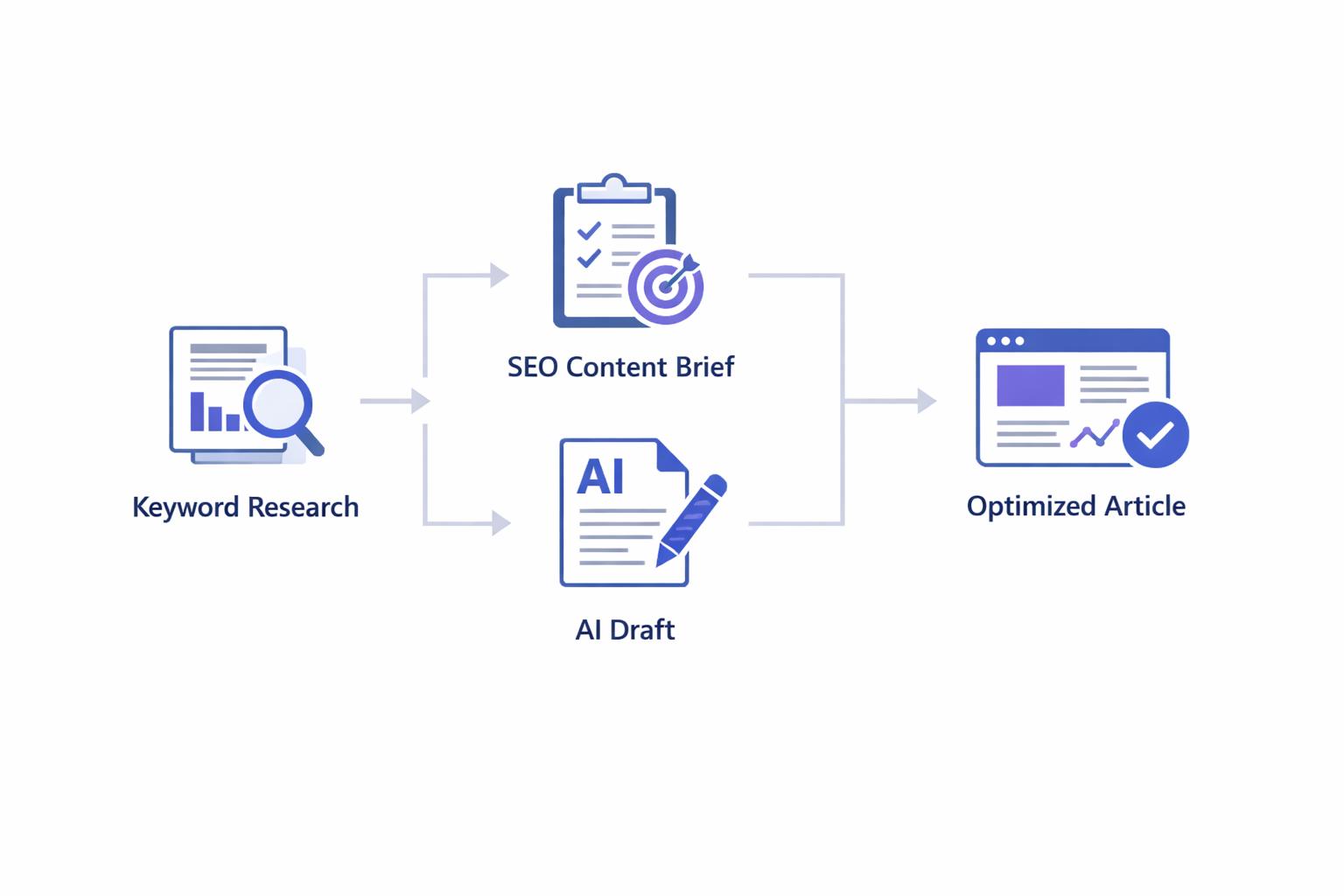
Once you’ve filled out the brief, you still need to translate it into an effective AI writing brief. Here’s a simple process.
Combine the key parts of your brief into a single instruction block for the AI:
Paste the audience, voice, and goal
Paste the outline and on-page SEO requirements
Add explicit instructions (e.g., “Do not add new sections without asking”)
Using the following SEO content brief, write a first-draft blog post.

[Paste sections 1–11 of your brief here]

Important:
- Follow the outline and headings exactly.
- Use the primary keyword in the H1, at least one H2, and naturally in the body.
- Naturally incorporate secondary keywords where relevant.
- Do not fabricate statistics; if data is missing, suggest where data could be added.For important or complex posts, ask the AI to write one section at a time using the same brief. This reduces hallucinations and keeps each section tightly aligned to search intent.
In Supablog, you can generate full posts automatically, then use unlimited AI rewrites to refine specific sections that need more depth or a different angle.
Even with a strong brief, human review is non-negotiable. You should:
Check claims and statistics against primary sources (e.g., Ahrefs SEO studies)
Verify that the draft fully addresses the search intent and top SERP questions
Ensure internal links and CTAs are accurate and up to date
Our AI blog post checklist walks through a 25-step review process you can run on every AI-assisted draft.
Once your brief template is working, the next step is scale. You can:
Standardize briefs across all writers and AI tools
Store them as templates in your documentation or project management tool
Use an AI blogging platform like Supablog to connect keyword research, brief creation, drafting, and publishing
Supablog can automatically handle keyword discovery, generate SEO-optimized blog posts, create AI images, and publish to platforms like WordPress, Webflow, Shopify, and Framer—so your brief becomes the backbone of a repeatable system instead of a one-off document.

“Write about SEO content briefs” is a topic, not a brief. Always specify the outcome: what the reader should be able to do or understand by the end.
If your brief doesn’t clearly state whether the intent is informational, commercial, or transactional, AI will guess—and often guess wrong. Your SEO content brief template should always include intent and example queries.
Stuffing your brief with dozens of exact-match keywords encourages awkward, spammy writing. Focus on one primary keyword and a curated set of secondary phrases, and instruct the AI to use them naturally.
“Professional tone” is too generic. Give concrete examples (“Write like a senior content strategist explaining this to a new hire”) and specify audience knowledge level.
Leaving meta tags, URL structure, and internal links as an afterthought leads to missed opportunities. Your on-page SEO brief section ensures every draft is closer to publish-ready.
Use this quick checklist to QA your brief before you ever hit “Generate.”
Primary keyword and search intent are clearly defined and realistic.
Outline covers the core topics shown in the top-ranking SERP results (plus your unique angle).
Audience, experience level, and voice guidelines are specific—not generic.
On-page SEO elements (slug, meta title, meta description, internal links) are filled in.
Examples, use cases, and any critical data sources are listed.
Explicit AI instructions clarify what to do, what not to do, and how to handle uncertainty.
After the AI generates your draft, run it through a structured review process. Our AI blog post checklist and guide to measuring the ROI of AI content marketing will help you connect these briefs to real traffic, leads, and revenue.
If you’re ready to turn this SEO content brief template into a fully automated system—from keywords to AI briefs to published posts—Supablog’s AI blogging platform can help. Start a 14-day free trial, generate up to 30 SEO-optimized articles per month, and see how much easier content ops feel when the brief is built into the workflow.
Written by
Pranjal JainFounder of Supablog, Pranjal is a software engineer passionate about building SaaS products that empower founders to grow and scale their businesses. With a strong focus on practical innovation, he creates tools that solve real-world challenges in the SaaS ecosystem. Outside of building and writing, he enjoys reading and traveling, drawing inspiration from new ideas, cultures, and experiences.