The Complete Guide to AI Content Marketing for Organic Growth
Understand how AI reshapes content strategy, production, and distribution so you can grow traffic without growing headcount.

Understand how AI reshapes content strategy, production, and distribution so you can grow traffic without growing headcount.
Pranjal Jain
AI content marketing has moved beyond hype. Teams are using it right now to publish more, rank faster, and grow organic traffic without hiring a small newsroom.
But there’s a catch: simply plugging a topic into an AI writer and hitting publish won’t get you sustainable results. To win, you need a clear AI content marketing strategy that connects research, production, optimization, and distribution into one system.
This guide walks through that system end-to-end: how AI reshapes content strategy, where it fits in your workflow, which metrics to track, and how platforms like Supablog help you scale without sacrificing quality. For a deeper look at the execution side, you can pair this with our content workflow automation with AI tools tutorial.
By the end, you’ll know exactly how to use AI for content marketing to grow organic traffic, not just publish more words.
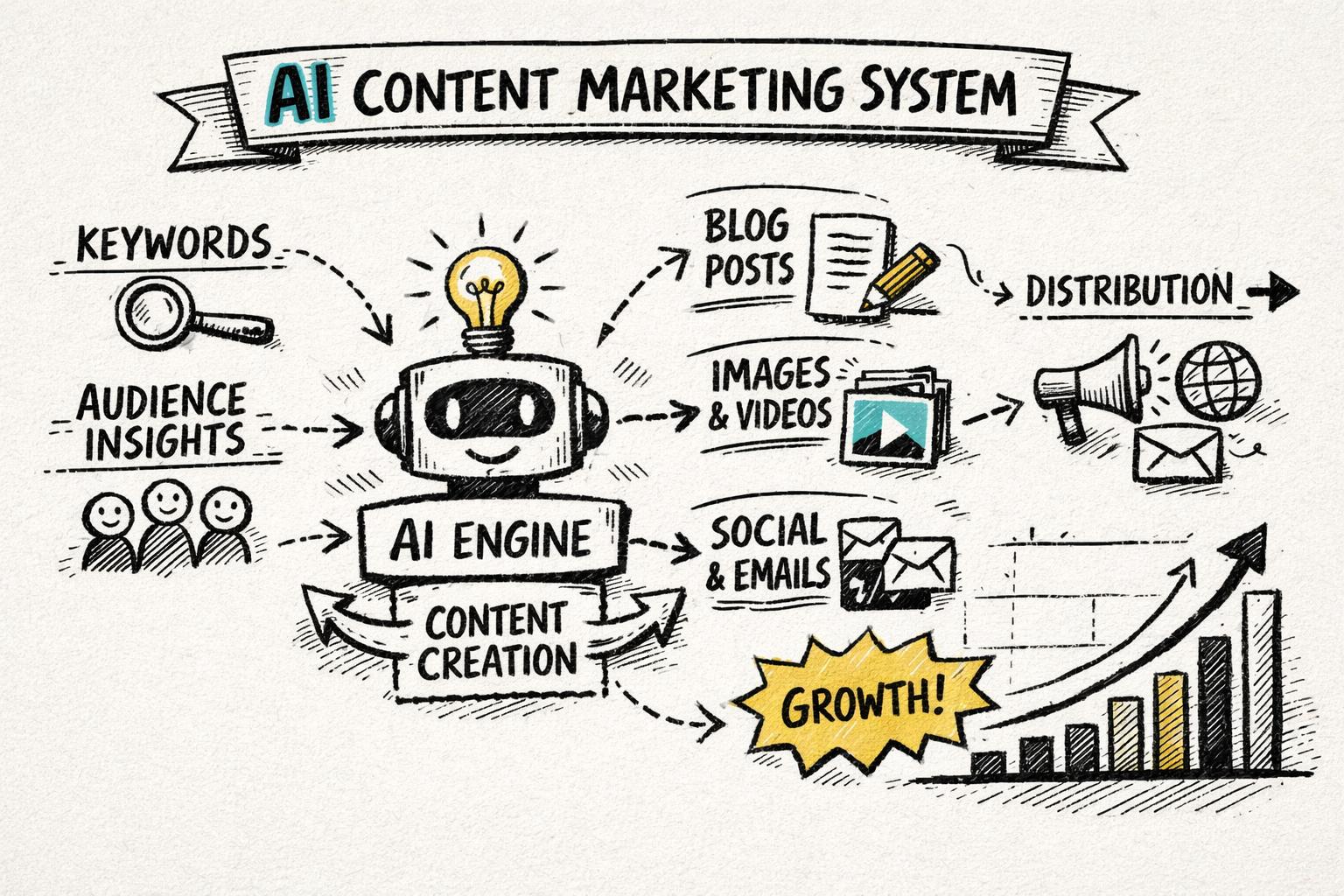
AI content marketing is the practice of using artificial intelligence to plan, create, optimize, and distribute content that attracts and converts your audience—especially through organic channels like search.
Instead of replacing strategy or human judgment, AI augments your team at every step:
Strategy: Analyze search demand, competitors, and audience questions at scale.
Creation: Draft articles, outlines, and variations quickly, then refine with human editing.
Optimization: Suggest keywords, headings, internal links, and on-page SEO improvements.
Distribution: Repurpose content into emails, social posts, and summaries.
Measurement: Surface what’s working so you double down on winning topics and formats.
Done well, AI content marketing lets you ship 3–10x more high-quality content without 3–10x the headcount.
Organic search is more competitive than ever. New content goes live every second, and search engines increasingly reward depth, freshness, and topical authority.
AI helps you compete by:
Expanding your surface area: Cover more topics, formats, and languages than a small team could manually.
Improving speed to publish: Go from idea to optimized draft in hours instead of weeks.
Maintaining consistency: Keep a steady publishing cadence, which is strongly correlated with organic growth.
Unlocking data-driven decisions: Use AI to analyze SERPs, competitors, and performance data at scale.
According to Content Marketing Institute’s research, top-performing content marketers are more likely to use technology to understand audience preferences and measure performance. AI is now the fastest way to operationalize that advantage.
To move beyond random AI experiments, structure your approach around five pillars:
1. Strategy: Decide what to publish and why.
2. Production: Turn strategy into drafts efficiently.
3. Optimization: Make each piece rankable and useful.
4. Distribution: Get content in front of the right people.
5. Measurement & iteration: Learn, refine, and compound results.
We’ll walk through each pillar, with concrete ways to use AI and where a platform like Supablog fits into the stack.
Most AI mistakes start here: teams skip strategy and jump straight into drafting. Instead, use AI to build a content strategy that aligns with your business goals.
Start from revenue, not keywords. Clarify:
Your core product or service and ideal customer profiles.
Key problems your product solves.
Buying triggers and objections.
Then prompt AI tools to generate topic clusters around those problems. For example, a B2B SaaS selling an analytics platform might create clusters like “marketing dashboards,” “attribution modeling,” and “data governance.”
To keep this organized over time, use an AI-assisted editorial calendar. Our AI blog content calendar template shows how to turn strategy into a month-by-month publishing plan.
Traditional keyword research is manual and slow. AI accelerates it by:
Expanding seed keywords into long-tail variations and questions.
Clustering keywords into logical groups that can share a pillar page.
Summarizing SERP intent for a query (informational, commercial, etc.).
You should still validate search volume and difficulty with standard SEO tools, but AI can do the heavy lifting of ideation and clustering. Supablog, for example, includes automatic keyword research so you can generate content ideas on autopilot.
With your topics defined, use AI to map each idea to a funnel stage:
Top-of-funnel (TOFU): Educational guides (like this one) that build awareness.
Middle-of-funnel (MOFU): Comparisons, case studies, and how-tos tied to your product.
Bottom-of-funnel (BOFU): Product pages, demos, pricing, and implementation guides.
Ask AI to suggest TOFU, MOFU, and BOFU angles for each topic, then prioritize based on your current funnel gaps.
This is where most people start with AI for content marketing—and where many go wrong. The goal is not to auto-generate hundreds of generic posts. It’s to combine AI speed with human expertise.
The quality of your AI output is only as good as your input. That means you need structured, detailed briefs that tell the AI exactly what to produce.
A strong AI content brief typically includes:
Primary and secondary keywords.
Target audience and stage of awareness.
Search intent and angle (e.g., “practical how-to for marketers”).
Outline with H2/H3s and key points per section.
Brand voice and examples of on-brand content.
Internal resources or product features to reference.
If you’re building briefs manually or with AI, our SEO content brief template for AI writers gives you a plug-and-play structure you can adapt.
An effective AI drafting process looks like this:
Outline first: Use AI to propose several outlines, then edit and combine the best ideas.
Section-by-section drafting: Generate content in chunks (per heading) instead of one giant pass.
Expert review: Have a subject-matter expert refine arguments, add examples, and correct inaccuracies.
Voice and clarity pass: Use AI again to tighten language, improve transitions, and simplify complex explanations.
This “AI + editor” loop is where most of the quality gains come from. Supablog bakes this into an AI blog writer flow that goes from idea to SEO-optimized draft quickly, while still allowing unlimited rewrites and edits.
Content isn’t just text. AI can also help you create:
Custom images that illustrate concepts, instead of relying on generic stock photos.
Embedded video suggestions, such as relevant YouTube videos to enrich your posts.
Code snippets, tables, and examples for technical content.
Supablog, for instance, includes AI image generation and relevant YouTube video integration directly in the article workflow, so every post is more engaging without extra design work.
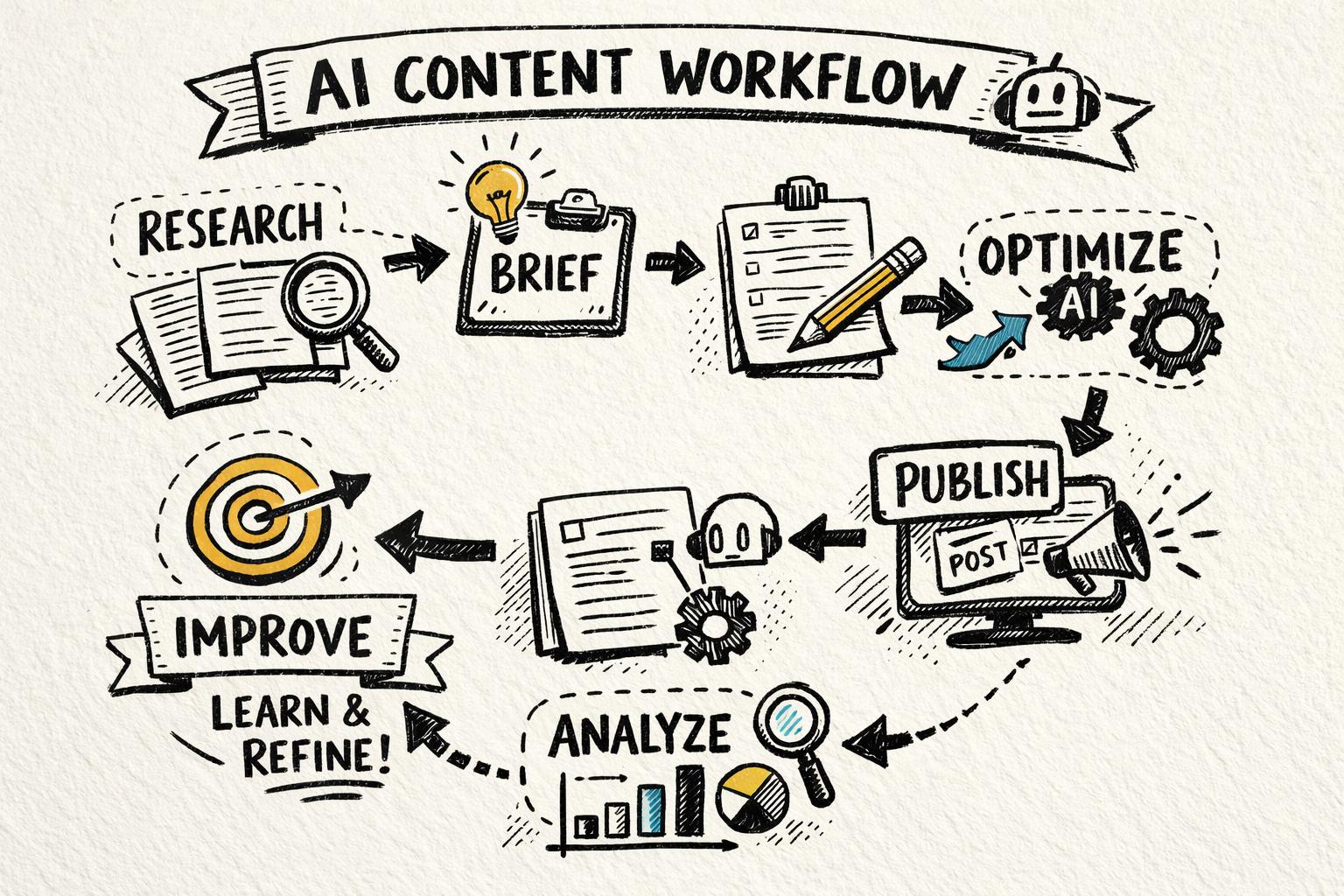
Even the best AI draft won’t rank if it doesn’t match search intent, demonstrate expertise, and follow on-page SEO best practices.
AI can quickly audit and improve your drafts by checking for:
Clear primary keyword targeting in title, intro, and headings.
Related entities and semantic keywords that signal topical depth.
Readable structure: short paragraphs, descriptive headings, and scannable lists.
Internal linking opportunities to and from other relevant pages.
Our AI SEO content optimization tutorial walks through a repeatable process to take any draft—human or AI—and make it search-ready.
Search engines increasingly emphasize Experience, Expertise, Authoritativeness, and Trust (EEAT). AI can’t manufacture this for you, but it can help you express it.
Best practices include:
Fact-checking AI-generated claims against authoritative sources (e.g., Google Search Central blog, industry reports).
Adding expert commentary from your team—quotes, opinions, and real examples.
Referencing data with clear citations to studies or benchmarks.
Maintaining author bios that highlight relevant experience.
AI can help draft sections and suggest structure, but humans must own accuracy and insight.
Before you hit publish on any AI-assisted article, run through a checklist for:
Originality and plagiarism.
Brand voice consistency.
Clear next steps or calls to action.
Technical SEO basics (meta tags, alt text, URL structure).
If you’re using AI at scale, a standardized review process is non-negotiable. Our AI blog post checklist gives you 25 steps to catch issues before they go live.
Publishing is just the start. To maximize ROI from each piece, use AI to repurpose and distribute content across channels.
From one in-depth article, AI can help you generate:
Short LinkedIn or X (Twitter) posts that highlight key insights.
Email newsletter segments summarizing the main takeaways.
Slide outlines for webinars or internal training.
FAQ snippets for support or sales enablement.
This allows you to maintain a strong presence across channels without manually rewriting everything.
If you manage multiple sites or CMSs, AI-powered platforms can streamline publishing. Supablog, for example, supports multi-platform publishing to WordPress, Webflow, Shopify, Framer, and more from a single dashboard.
Instead of copying and pasting into each CMS, you can:
Generate and optimize the article once.
Customize intros or CTAs by platform if needed.
Publish everywhere in a few clicks.
Organic growth isn’t just about content volume; it’s also about authority. AI can assist with outreach personalization and identifying relevant sites, while platforms like Supablog add automated backlink exchange to help you earn high-DR backlinks at scale.
Combine this with manual relationship-building for the best long-term results.
To keep budget and stakeholder support, you must show that AI-assisted content is driving real business outcomes, not just more traffic.
At a minimum, measure:
Organic traffic growth: Sessions and users from organic search over time.
Keyword rankings: Number of keywords in top 3, top 10, and top 50 positions.
Engagement: Time on page, scroll depth, and bounce rate.
Conversions: Demo requests, signups, or purchases attributed to content.
Content efficiency: Cost and time per article vs. baseline.
For a deeper breakdown of how to connect these to revenue, see our guide on measuring the ROI of AI content marketing.
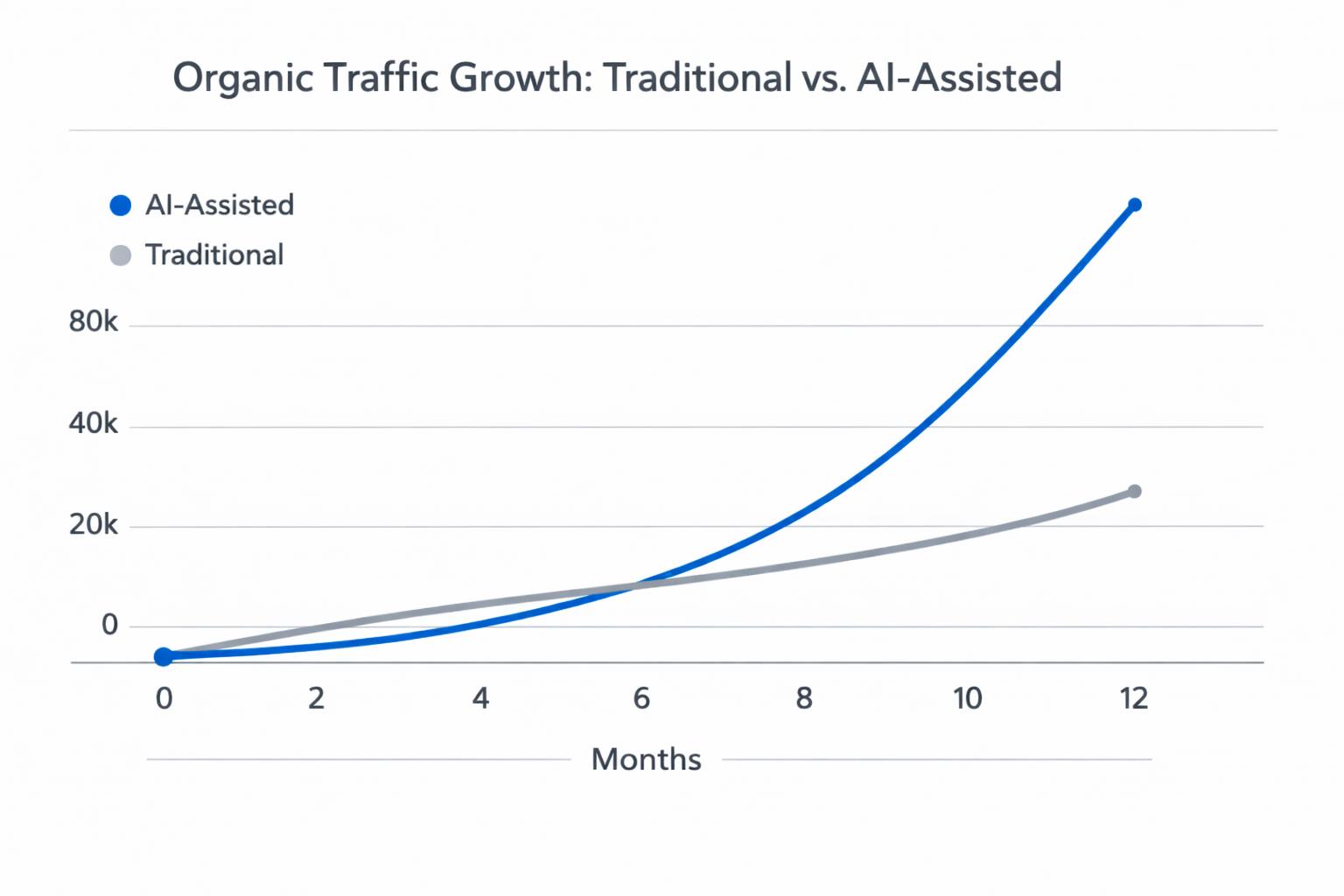
One practical approach is to run a controlled comparison:
Pick similar topics and difficulty levels.
Create half the content with your traditional process, half with AI-assisted workflows.
Track performance over 3–6 months.
Many teams find that AI-assisted content allows them to publish more consistently and cover more long-tail keywords, which compounds into higher overall traffic and leads.
To truly scale content with AI, you need more than individual tools—you need a workflow that connects them.
Here’s an end-to-end workflow many teams adopt:
Research & planning: Use AI to expand topics, cluster keywords, and map funnel stages.
Brief creation: Generate structured briefs with goals, outlines, and SEO requirements.
Drafting: Produce first drafts section-by-section with AI, guided by the brief.
Expert review: Subject-matter experts revise, add insights, and approve.
Optimization: Run AI-assisted SEO checks and refine structure and internal links.
Publishing: Push to your CMS (or multiple CMSs) with consistent formatting.
Distribution: Repurpose into social, email, and sales enablement content.
Analytics & iteration: Review performance monthly and feed learnings back into planning.
Supablog is built to support this exact loop—from automatic keyword research to AI drafting, optimization, image generation, and analytics—so you can manage everything in one place.
As you add automation, keep a clear line between:
Tasks to automate: Formatting, initial drafts, SEO checks, internal link suggestions, image generation.
Tasks to keep human: Topic selection, positioning, final approvals, and anything that touches brand or legal risk.
This balance lets you scale content while protecting brand integrity.
The AI content marketing landscape is crowded. To avoid tool sprawl, focus on a stack that covers your end-to-end needs with minimal overlap.
AI writing assistants: For drafting, rewriting, and summarizing content.
SEO & research tools: For keyword research, SERP analysis, and content gap identification.
Content workflow platforms: For planning, collaboration, approvals, and publishing.
Analytics & attribution tools: For measuring impact across channels.
AI design and image tools: For generating visuals and social assets.
Supablog combines several of these into one AI-powered blogging platform: content generation, SEO optimization, AI images, multi-platform publishing, and performance analytics.
When evaluating AI marketing tools, consider:
Does it integrate with your existing CMS and analytics stack?
Can it handle scale—multiple sites, languages, and users?
How does it handle data privacy and model training?
Is the pricing aligned with your expected content volume and ROI?
Does it support collaboration across writers, editors, and stakeholders?
Look for tools that reduce friction rather than adding more steps to your process.
AI can accelerate growth—or amplify problems. Watch out for these pitfalls:
Search engines are increasingly good at detecting low-value content. If you flood your site with shallow AI posts, you risk diluting your brand and hurting overall site quality.
Solution: Set a quality bar and enforce it with human review and a pre-publish checklist. Focus on depth, originality, and real examples.
Even a beautifully written article will underperform if it doesn’t answer the question behind the query. AI sometimes misreads or oversimplifies intent.
Solution: Manually review SERPs for your target keywords. Use AI to summarize patterns, but decide for yourself what the piece must cover to be truly useful.
Fully automated pipelines that publish AI content with no checks are risky—from factual errors to off-brand messaging.
Solution: Keep humans in the loop, especially for sensitive topics. Establish guidelines on where AI is allowed and where it isn’t.
Without clear metrics, you can’t tell if AI is helping or just creating more work.
Solution: Define baseline metrics, run experiments, and review results regularly. Our ROI framework in how to measure AI content marketing ROI can help.
AI content marketing works best as a system, not a side project. Sporadic experiments won’t move the needle.
Solution: Build repeatable workflows, document best practices, and train your team. Use resources like our AI blog post checklist and workflow automation guide to standardize how you work.
AI can accelerate content production immediately, but SEO results still take time. Industry data from sources like Ahrefs’ ranking studies suggest that meaningful organic traction often takes 3–12 months, depending on competition and domain authority.
AI helps you:
Publish more consistently over that time window.
Cover more long-tail queries that are easier to rank for.
Iterate faster on underperforming content.
But it doesn’t bypass the fundamentals of SEO or the need for links, technical health, and strong user engagement.
Supablog is an AI blogging platform built specifically for teams that want to scale organic traffic without growing headcount. It brings your AI content strategy, production, and distribution into one place.
AI article generation for SEO-optimized blog posts, with unlimited rewrites.
Automatic keyword research to surface topics and opportunities hands-free.
Built-in SEO optimization with keyword suggestions and on-page best practices.
AI image generation in multiple styles to make posts visually engaging.
Multi-platform publishing to WordPress, Webflow, Shopify, Framer, and more.
Performance analytics to track which posts drive traffic and conversions.
Automated backlink exchange to help grow domain authority.
Support for 150+ languages for global content strategies.
Supablog is ideal for:
Content marketers and SEO teams who need to scale blog output.
Agencies managing multiple client blogs and CMSs.
Solo founders and creators who want professional, SEO-ready articles without hiring a full team.
With a 14-day free trial and plans starting at $99/month for 30 AI-generated and auto-published articles, it’s designed to pay for itself quickly as your organic traffic grows.
AI content marketing isn’t about replacing marketers—it’s about giving them leverage. To recap, you’ll get the best results when you:
Anchor your AI efforts in a clear content strategy tied to business goals.
Use AI for research, drafting, and optimization—while keeping humans in charge of judgment and quality.
Standardize your workflows with briefs, checklists, and analytics.
Invest in a platform that connects the dots from idea to publish to performance.
If you’re ready to turn AI content marketing into a reliable engine for organic growth, explore how Supablog can power your workflow—from automatic keyword research to SEO-optimized publishing and analytics.
Then, use resources like our AI content calendar template and SEO optimization tutorial to keep every piece you publish focused, search-ready, and aligned with your growth goals.
Written by
Pranjal JainFounder of Supablog, Pranjal is a software engineer passionate about building SaaS products that empower founders to grow and scale their businesses. With a strong focus on practical innovation, he creates tools that solve real-world challenges in the SaaS ecosystem. Outside of building and writing, he enjoys reading and traveling, drawing inspiration from new ideas, cultures, and experiences.