AI Blog Post Checklist: 25 Steps Before You Hit Publish
Run every AI-generated article through this checklist to avoid thin content, SEO gaps, and brand voice issues.

Run every AI-generated article through this checklist to avoid thin content, SEO gaps, and brand voice issues.
Pranjal Jain
AI makes it easy to go from keyword to draft in minutes. The risk is just as big: thin content, off-brand tone, and posts that never rank.
This AI blog post checklist gives you 25 concrete checks to run after generation and before you hit publish. Use it to turn raw AI drafts into authoritative, search-ready articles that actually drive leads.
If you’re building a system around this, pair it with a solid SEO content brief for AI writers so you start with the right inputs, then use this checklist as your final QA pass.
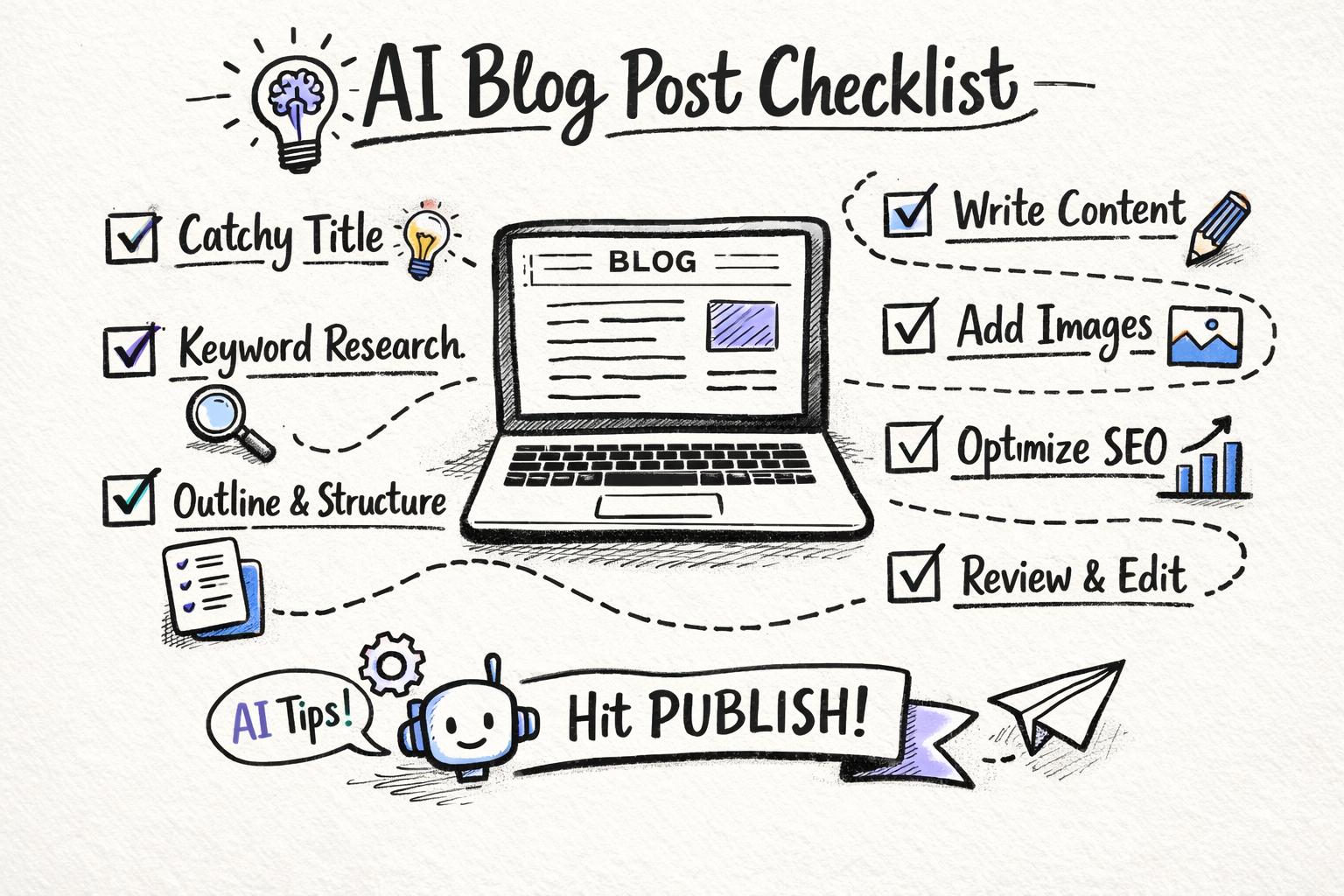
This is a post-generation, pre-publish checklist. Assume you already have an AI draft from a tool like Supablog, ChatGPT, or another AI blog writer.
Work through the 25 steps in order. You can treat them as a blog publishing checklist across four phases:
Content substance & originality
Brand voice & readability
On-page SEO & structure
Final polish & publishing
For a more automated workflow, see how to automate your content workflow with AI tools and embed this checklist into your process.
AI often writes around a topic instead of to the point. Re-read the draft and ask:
Is this post clearly answering what someone searching “ai blog post checklist” wants?
Would a marketer mid-funnel (evaluating AI tools and workflows) feel this is practical and detailed enough?
If not, add missing sections or reframe the intro and conclusion to match the reader’s real goal.
Skim each section and highlight anything that feels vague, obvious, or repetitive. Ask:
Does each H2/H3 provide specific, actionable guidance?
Are there concrete examples, steps, or criteria—not just definitions?
Remove filler and replace it with clear steps, examples from your own process, or data points.
Google’s EEAT guidelines reward content that shows real-world use. Add:
How your team actually uses AI in your content workflow
Specific scenarios (e.g., “We run every AI draft through this 25-step checklist before publishing on Supablog”)
Lessons learned from posts that performed well—or flopped
This is where you differentiate from thousands of AI-generated clones.
AI hallucinations are still a real risk. For any numbers, tools, or research mentioned:
Verify against the original source (e.g., Google’s helpful content system or a reputable marketing report)
Link to authoritative sources like Ahrefs’ SEO studies or Backlinko’s research-backed guides
Update or remove anything you can’t confidently support.
Scan for:
Made-up product features or pricing
Fake statistics (“studies show 87%…”) without a real citation
Quotes that don’t exist or can’t be sourced
Replace with real examples from your product (e.g., Supablog’s 14-day free trial, 30 AI-generated articles per month, or backlink exchange) and verified data.
Search your primary keyword and open the top 5–10 results. Compare your draft:
Are you just repeating the same bullets with slightly different wording?
Have you added anything uniquely valuable (templates, frameworks, screenshots, or workflow diagrams)?
Insert 1–2 unique elements, such as a downloadable checklist or a workflow tailored to AI-assisted teams.
Every post should ladder up to a larger strategy. Check:
Does this article support your pillar content, like your AI content marketing guide?
Is there a clear path from this checklist to your product or next-step content?
If not, add internal links and CTAs that move readers deeper into your funnel.
AI defaults to generic corporate tone. Edit for:
Vocabulary that matches your brand (e.g., “playbook” vs. “guide”)
Sentence length and rhythm (short and punchy vs. long and narrative)
Point of view (first person plural “we” vs. neutral third person)
Create a small voice checklist (do/don’t phrases) and keep it next to this AI content quality checklist.
Your first 4–6 lines determine whether readers stay. Ensure the intro:
Names the reader’s problem (AI drafts that feel generic or risky)
Promises a clear outcome (a 25-step blog publishing checklist)
Signals who it’s for (content marketers, agencies, SaaS teams)
Remove any generic “In today’s digital world…” style openers.
Most readers scan. Apply:
2–4 sentence paragraphs
Descriptive subheadings that summarize the takeaway
Bulleted lists for steps, criteria, or examples
This also helps Google understand your structure and improves dwell time.
Replace vague verbs like “leverage” or “utilize” with direct actions:
“Run this query in your SEO tool…”
“Add a section that compares…”
“Create a table that summarizes…”
Readers should be able to implement each step without guessing.
AI can contradict itself across long drafts. Scan for:
Different definitions of the same term (e.g., “on-page SEO checklist” vs. “technical SEO checklist”)
Conflicting recommendations (publish weekly vs. monthly)
Standardize terminology and ensure your advice doesn’t clash within the same post or with your other content.
Avoid jargon your target audience wouldn’t use and watch for unintentionally exclusionary phrases. Ask:
Would a mid-level marketer understand this without Googling terms?
Is the tone respectful and professional throughout?
Adjust wording to keep the article approachable and aligned with your brand values.
“AI can write a draft, but it cannot be accountable for what you publish. That’s your job—and your competitive advantage.”

This is where many AI-generated posts fail. Even a strong draft needs a deliberate SEO checklist for blog posts to stand a chance at ranking.
Confirm that your primary keyword (e.g., “ai blog post checklist”) appears naturally in:
Title and H1
First 100–150 words
At least one H2 or H3
URL slug (if you control it)
Then, ensure you’ve covered related subtopics users expect. Tools like Ahrefs, Semrush, or Google’s “People Also Ask” can help.
Don’t let AI auto-generate vague metadata. Manually write:
A meta title that includes your primary keyword and a clear benefit (50–60 characters)
A meta description that teases the outcome and includes a secondary keyword (120–155 characters)
Think of this like ad copy for your organic result.
Review your H2/H3 hierarchy:
Each H2 should represent a clear section or question
H3s should break down steps, criteria, or subtopics
Avoid keyword stuffing; use variations naturally
A clean structure helps both readers and search engines parse your content.
Internal links are critical for topical authority and user flow. Add links to:
Pillar content, like your complete guide to AI content marketing for organic growth
Adjacent how-tos, such as an AI SEO content optimization tutorial
Content planning resources, like your AI blog content calendar template
Use descriptive anchor text that sets clear expectations.
Outbound links to authoritative sites can improve trust. Link to:
Official documentation (e.g., Google’s guidance on helpful content)
Respected industry studies or benchmarks
Keep it to a handful of strong references rather than dozens of low-value links.
AI tools make it easy to generate visuals, but they still need optimization:
Use descriptive file names and alt text that explain the image
Ensure images support the content (e.g., workflow diagrams, checklists, charts)
Compress images for fast load times
If you’re using Supablog, you can generate on-brand images directly in the editor and keep everything in one workflow.
Make sure the post is easy to find and share:
Short, descriptive URL including the primary keyword
Logical placement in your blog categories or topic clusters
Breadcrumbs or navigation that show where this fits in your site structure
This supports both SEO and user experience.
Even the best content can underperform if the technical layer is broken. Confirm:
Page is indexable (no accidental noindex tags)
Canonical tags are correct
Core Web Vitals are within acceptable ranges
Coordinate with your dev or SEO team if you don’t control these directly.
AI grammar is good, not perfect. Do a focused edit for:
Typos, awkward phrasing, and repeated words
Broken logic or missing transitions between sections
Formatting inconsistencies (heading styles, bullet types, spacing)
If possible, have a second person skim for clarity and correctness.
Every MOFU article should guide readers to a next step. For an AI blog checklist, that might be:
Starting a free trial of your AI blogging platform
Downloading a PDF version of the checklist
Booking a demo to see how you automate this process
Place 1–2 contextual CTAs in the body and a clear CTA near the conclusion.
Before you publish, decide how you’ll drive initial traction:
Share a summarized version in your newsletter
Turn the 25 steps into a social carousel or short video
Use key sections as scripts for YouTube videos you can later embed
Supablog can auto-embed relevant YouTube videos into your posts to improve engagement and time on page.
Finally, add the post to your tracking sheet or analytics dashboard:
Record target keyword, publish date, and primary CTA
Set reminders to review performance at 30, 60, and 90 days
Compare results against other posts that followed the same checklist
If you’re not yet measuring outcomes, use a framework like the one in our guide on measuring the ROI of AI content marketing to close the loop.
Running through 25 steps once is helpful. Building them into your workflow is where the real leverage comes from.
With Supablog, you can:
Generate SEO-optimized drafts based on automatic keyword research
Use AI to rewrite and refine sections as you apply this checklist
Auto-generate on-brand images and publish to WordPress, Webflow, Shopify, and more from one dashboard
Track performance and backlinks so you see which checklist-optimized posts drive the most organic growth
Pair this ai blog post checklist with a solid strategy, a consistent calendar, and the right tooling, and you’ll ship more content that ranks, converts, and actually sounds like you.
When you’re ready to scale, explore how Supablog can help you go from “AI draft” to “published, revenue-driving asset” in a fraction of the time—without sacrificing quality.
Written by
Pranjal JainFounder of Supablog, Pranjal is a software engineer passionate about building SaaS products that empower founders to grow and scale their businesses. With a strong focus on practical innovation, he creates tools that solve real-world challenges in the SaaS ecosystem. Outside of building and writing, he enjoys reading and traveling, drawing inspiration from new ideas, cultures, and experiences.