How to Measure the ROI of AI Content Marketing
Track the right metrics so your AI-assisted blog strategy clearly ties to traffic, leads, and revenue.

Pranjal Jain
Track the right metrics so your AI-assisted blog strategy clearly ties to traffic, leads, and revenue.
Pranjal Jain
AI has made it easier than ever to publish more content, faster. But if you can’t clearly measure AI content marketing ROI, it’s just more noise and more spend on tools.
This tutorial walks you step-by-step through how to measure the ROI of AI-assisted blogging so you can prove impact on traffic, leads, and revenue—not just word count.
We’ll define a simple measurement framework, pick the right metrics, and show how a platform like Supablog makes tracking and improving ROI much easier. If you’re still designing your overall AI content strategy, read our complete guide to AI content marketing for organic growth alongside this tutorial.
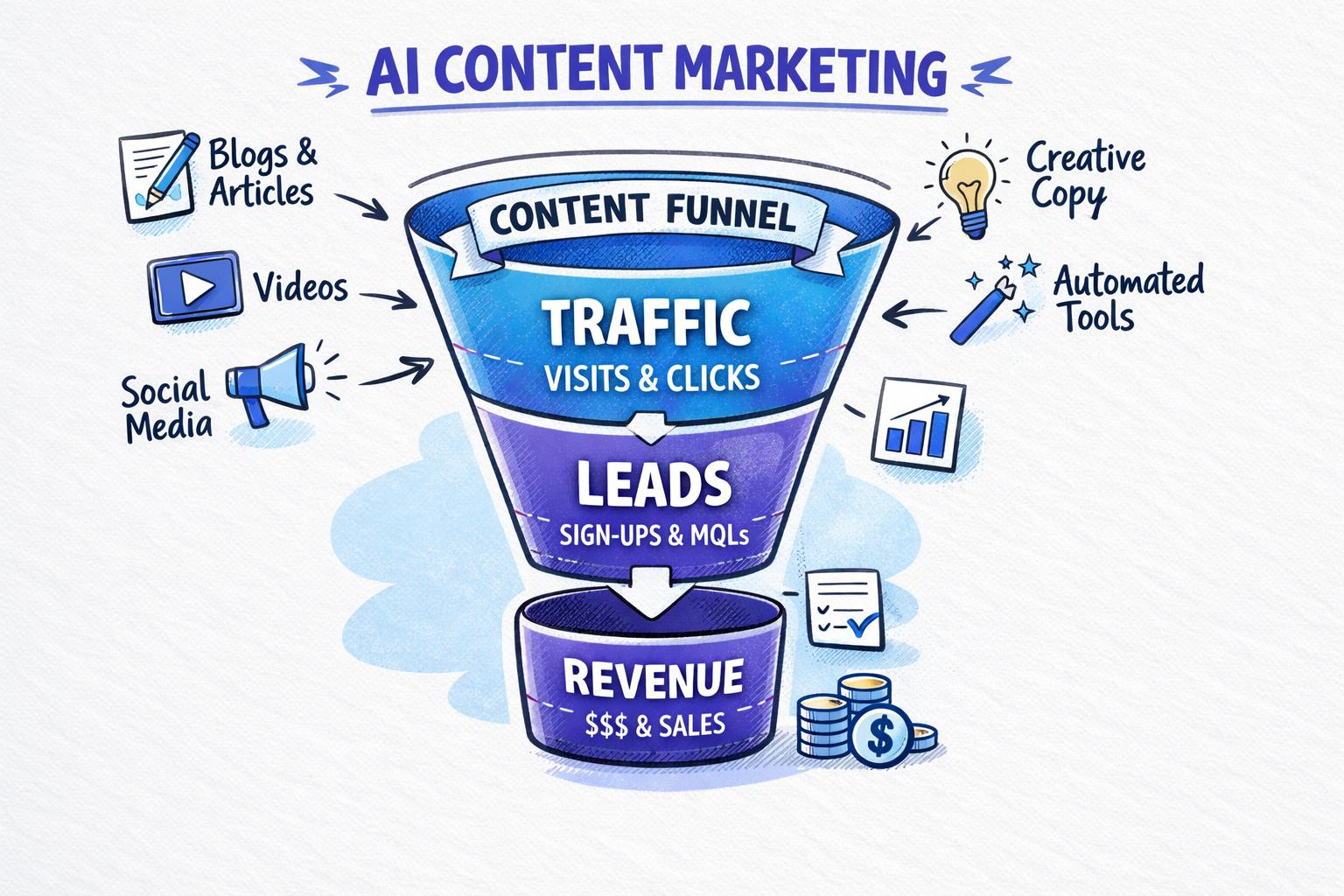
Traditional content ROI is already hard to measure. AI adds new variables: content volume increases, production costs change, and quality can swing both up and down.
Instead of asking “Is AI content good or bad?”, you need to ask: “Is AI improving the unit economics of my content program?”
That means tracking how AI affects:
Cost per article (time + tools + people)
Output volume (how many SEO-ready posts you publish)
Performance per article (traffic, leads, revenue per post)
Time to impact (how quickly posts start ranking and converting)
We’ll turn these into concrete metrics and formulas you can plug into your analytics stack or into a platform like Supablog that already includes blog performance analytics.
Before you calculate ROI, clarify what exactly counts as “AI content marketing.” Are you measuring:
Only AI-assisted blog posts (e.g., drafts started by an AI blog writer, then edited by humans)?
Fully AI-generated articles with light human review?
Hybrid workflows where AI helps with briefs, outlines, or SEO optimization, but writing is human-led?
Document this clearly. Your ROI calculation is only as good as your definition of what’s in and out of scope.
For example, with Supablog, you might define AI content as:
Posts created using the AI article generator or AI blog writer
Posts where keyword research was done via automatic keyword research
Posts published via blog automation software workflows
To measure ROI, you need a comparison point: what results looked like before you adopted AI for content.
Gather 3–12 months of historical data for your blog program, including:
Production metrics: number of posts per month, average word count, topics
Cost metrics: writer fees or salaries, editor time, SEO support, tools
Performance metrics: organic sessions, assisted conversions, leads, revenue, rankings
From this, calculate your baseline:
Average cost per article
Average organic traffic per article (over 6–12 months)
Average leads and revenue per article
If you’re not sure how to structure this analysis, our AI SEO content optimization tutorial shows how to turn raw content data into actionable insights.
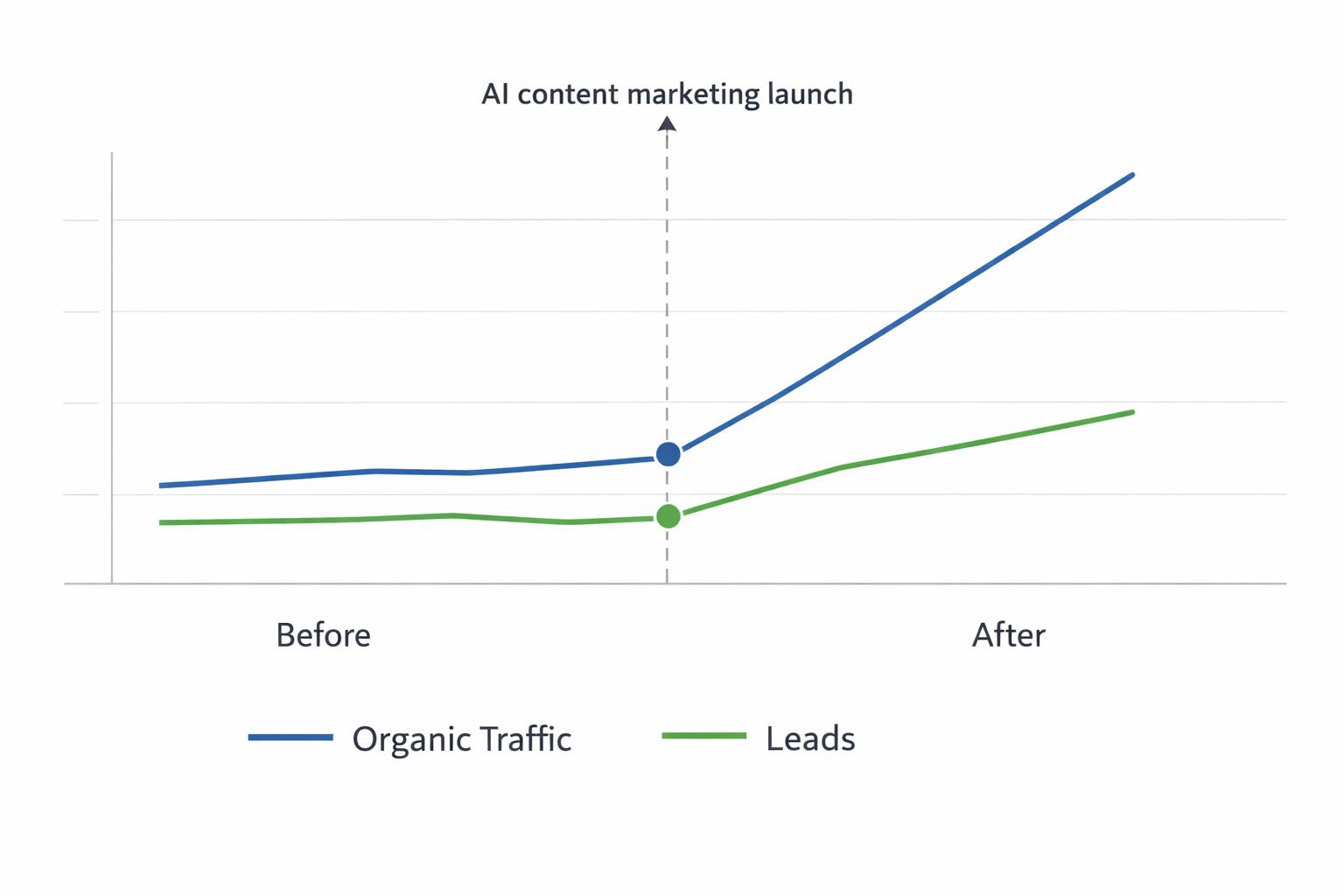
ROI starts with cost. For AI content, make sure you include:
Tool costs: AI blogging platform, SEO tools, image generation, analytics
Human time: strategy, outlines, editing, fact-checking, publishing
Overhead: training team on new workflows, process setup, QA
At a minimum, calculate:
Total monthly AI content cost = (AI tools + human time on AI content)
Cost per AI-assisted article = Total monthly AI content cost / # AI-assisted posts
This is where Supablog’s pricing model is intentionally simple: one flat plan (e.g., $99/month) for up to 30 AI-generated and auto-published articles, plus unlimited users. That makes it easier to attribute per-article costs and compare them to your pre-AI baseline.
Now you can define the key metrics that will tell you whether AI is helping or hurting your content program.
Organic sessions from AI content: total search traffic to URLs tagged as AI-assisted
Traffic per AI article: organic sessions / # AI articles live
Time to first ranking: days from publish to first top-20 keyword ranking
Use Google Search Console or your SEO tool to segment performance by URL. You can tag or group AI-assisted posts to isolate their impact. Google’s own guidance on AI-generated content is worth reviewing to ensure your strategy stays aligned with Search Essentials.
Average engagement time (GA4) for AI vs non-AI posts
Scroll depth and bounce rate by content type
On-page actions (table of contents clicks, internal link clicks, video plays)
These metrics show whether AI content actually holds attention or just inflates pageviews. If you embed YouTube videos or interactive elements, track those interactions too.
Leads from AI content: form fills, demo requests, signups attributed to AI URLs
Assisted conversions: conversions where AI posts appeared in the user journey
Revenue from AI content: closed-won deals or purchases attributed to AI URLs
In GA4, set up conversion events and use landing page and page path dimensions to see which blog posts contribute to conversions. For B2B, connect this with your CRM using UTM parameters and first-touch/last-touch models; resources like the HubSpot marketing statistics library can help benchmark your conversion rates.
Time to publish: average days from idea to live article
Articles per FTE: how many posts each marketer can ship per month
Cost per lead from AI content: total AI content cost / leads from AI posts
Efficiency is where AI usually shines—especially when paired with content workflow automation. Our guide to content workflow automation with AI tools goes deeper into designing these processes.
Once you have cost and performance, you can calculate ROI. There are three useful levels: traffic ROI, lead ROI, and revenue ROI.
Use this when your blog is still early and doesn’t yet drive many direct conversions.
Traffic value (monthly) = (Organic sessions from AI posts) x (Estimated value per visit)

Traffic ROI = (Traffic value - Total AI content cost) / Total AI content cost
To estimate value per visit, you can use:
Your average cost per click for paid search on similar keywords
Industry benchmarks from sources like Ahrefs content marketing statistics
Once you’re capturing leads from your blog, use:
Lead value (monthly) = (Leads from AI posts) x (Average value per lead)

Lead ROI = (Lead value - Total AI content cost) / Total AI content cost
Average value per lead can be approximated as:
Average value per lead = Close rate x Average deal sizeFor mature programs where you can attribute revenue directly or via assisted conversions:
Revenue ROI = (Revenue from AI posts - Total AI content cost) / Total AI content costCompare this to your pre-AI baseline to answer:
Are AI-assisted posts generating more or less revenue per article?
Has your total content-driven revenue grown faster than your content costs?
Are certain AI workflows (e.g., long-form SEO posts) more profitable than others?
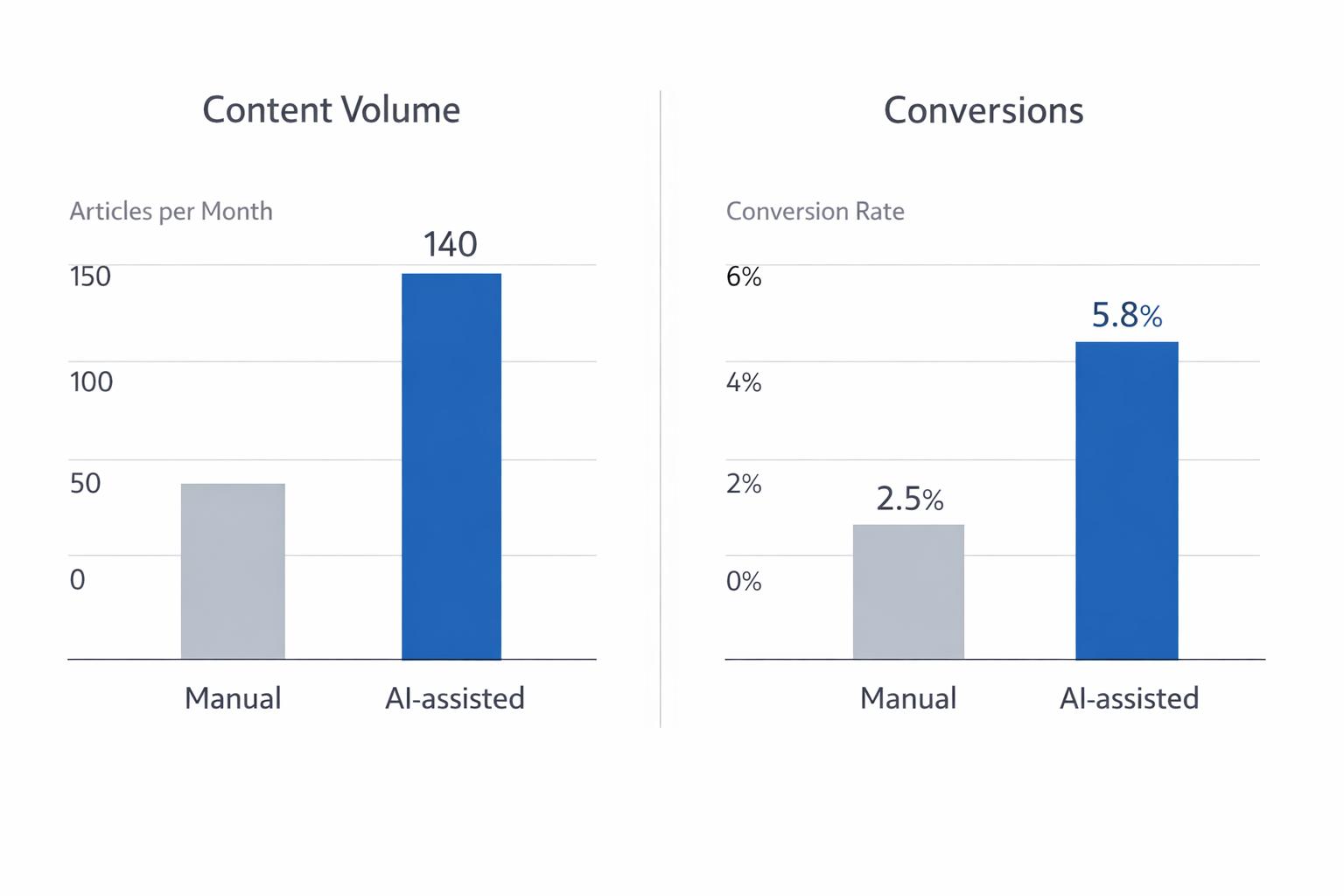
Let’s group the most important metrics into a practical dashboard you can review weekly or monthly.
# of AI-assisted posts published (this period)
Average word count and depth (are you shipping thin content or comprehensive guides?)
Average time spent per post (research, drafting, editing, publishing)
Cost per article (all-in, including tools and people)
Use these to ensure you’re not trading quality for volume. Our AI blog post checklist is a good safeguard against low-quality output that will hurt ROI long term.
New ranking keywords from AI posts
Share of impressions and clicks for AI vs non-AI posts
Average position for target keywords
Organic sessions per post after 30, 90, and 180 days
Supablog’s SEO-optimized blog posts and automatic keyword research help here by ensuring each article is mapped to a clear keyword opportunity from day one.
Engagement time per article
Return visitors to AI posts (are people coming back?)
Internal link click-through to product or feature pages
Qualitative feedback from sales, support, and customers
“You can’t optimize what you don’t measure—and you can’t measure what you haven’t clearly defined.”

Conversion rate by article (newsletter, trial, demo, purchase)
Pipeline influenced by AI posts (for B2B)
Customer acquisition cost (CAC) from organic
Lifetime value (LTV) of users acquired via AI content
These metrics require tight integration between your analytics, CRM, and content systems. Supablog helps by centralizing blog performance analytics and simplifying content performance tracking across platforms like WordPress, Webflow, Shopify, and Framer.
Attribution is where most teams struggle. AI can publish a lot of content quickly, but if you can’t tie that content to outcomes, budget conversations get messy.
Make it easy to isolate AI content in your analytics:
Use a URL naming convention (e.g., /blog/ai-…)
Add a custom dimension in GA4 (Content Type: AI vs Manual)
Use content groups or labels in your CMS or Supablog workspace
This lets you build reports that answer “What is AI content doing for us?” in one click.
No single attribution model is perfect. For AI content, look at at least three angles:
First touch: did an AI post start the user’s journey?
Last touch: was an AI post the final step before conversion?
Multi-touch: how often do AI posts appear anywhere in converting journeys?
Compare these views to understand whether AI content is better at awareness, consideration, or conversion. Then align your content formats accordingly (e.g., educational guides for awareness, comparison posts for conversion).
In GA4 or your BI tool, create a recurring report that includes:
Landing page (URL)
Content type (AI vs Manual)
Organic sessions
Conversions and conversion rate
Revenue (if available)
Publication date (to see performance over time)
Review this monthly to spot:
High-ROI AI posts worth expanding or updating
Underperforming posts that need better targeting, on-page SEO, or CTAs
Topics or formats where AI content consistently wins or loses
If you’re not sure how to prioritize updates, our AI blog content calendar template shows how to schedule refreshes based on performance data.
Publishing 50 AI-generated posts that don’t rank or convert is worse than publishing 10 strategic, optimized posts. Avoid vanity metrics like “words produced” or “articles per week” as your primary success measures.
Instead, focus on blog ROI metrics tied to business outcomes: cost per lead, revenue per article, and lifetime value of users acquired through organic search.
Low-quality AI content can damage trust, dilute your brand, and even trigger search penalties if it’s spammy or unhelpful. Always combine AI with:
Human editing and fact-checking
Clear brand voice guidelines
Topical expertise from subject-matter experts
Run every AI-generated article through a rigorous review process. Our AI blog post checklist is designed exactly for this.
If you lump all content together, you’ll never know whether AI is helping or hurting. Always tag AI content so you can compare:
Traffic per post (AI vs manual)
Conversion rate (AI vs manual)
Cost per lead (AI vs manual)
Over time, you may find that AI excels at certain content types (e.g., SEO how-tos) while humans outperform on others (e.g., thought leadership). Adjust your mix accordingly.
If you use the same briefs and processes you used for manual content, you’ll underutilize AI—or worse, produce generic, unfocused articles.
Design briefs specifically for AI writers, including clear objectives, target personas, and SEO requirements. Our SEO content brief template for AI writers gives you a plug-and-play format that maps directly to ROI.
Supablog is built to solve both sides of the ROI equation: better results and easier measurement.
AI content generation for blog posts that are SEO-optimized from the start
Automatic keyword research so every article targets a real opportunity
Unlimited AI rewrites to refine drafts without extra freelancer costs
This compresses your time to publish and reduces cost per article, while still giving you control over quality and brand voice.
SEO optimization with keyword suggestions and on-page best practices
AI image generation for blogs to improve engagement and shareability
Multi-platform publishing to WordPress, Webflow, Shopify, Framer, and more
Relevant YouTube video integration to boost on-page engagement
These features help each post attract more organic traffic and keep visitors on-page longer—key drivers of ROI.
Performance analytics for blog content so you can see what’s working
High DR backlinks via automated backlink exchange to lift rankings
Marketing content automation that keeps your calendar full without adding headcount
Because Supablog centralizes creation, optimization, and analytics, it’s much easier to attribute traffic, leads, and revenue to your AI content efforts and continuously improve your AI content marketing ROI.
To recap, measuring the ROI of AI content marketing comes down to a few disciplined steps:
Define what counts as AI content in your program.
Establish a clear pre-AI baseline for costs and performance.
Track the full cost of AI tools and human time.
Measure traffic, engagement, leads, and revenue for AI vs non-AI posts.
Calculate ROI at traffic, lead, and revenue levels—and iterate your strategy.
If you want a system that bakes these best practices into your workflow—from SEO content generator to blog performance analytics—Supablog can help. Start a 14-day free trial, ship your first batch of AI-assisted posts, and use the framework in this guide to track exactly how they move the needle for your business.
Written by
Pranjal JainFounder of Supablog, Pranjal is a software engineer passionate about building SaaS products that empower founders to grow and scale their businesses. With a strong focus on practical innovation, he creates tools that solve real-world challenges in the SaaS ecosystem. Outside of building and writing, he enjoys reading and traveling, drawing inspiration from new ideas, cultures, and experiences.