Improve Blog Conversion Rate: 9 Data-Backed Tweaks for AI-Generated Posts
Use analytics insights to optimize CTAs, layouts, and topics so your existing traffic converts into more leads and trials.

Use analytics insights to optimize CTAs, layouts, and topics so your existing traffic converts into more leads and trials.
Pranjal Jain
You’re already getting traffic to your AI-generated articles—but your pipeline barely moves. Sessions look good in analytics, yet trial signups, demo requests, and email subs lag behind.
This guide shows you how to improve blog conversion rate with 9 specific, data-backed tweaks you can apply to existing posts—especially AI-written ones.
We’ll focus on blog CTA optimization, layout changes, and topic decisions powered by analytics. If you’re also building a measurement foundation, pair this with our guide to building a blog analytics dashboard that actually guides content decisions.
Everything below is designed for BOFU and MOFU content marketers using tools like Supablog or other AI blogging platforms who want more leads from the traffic they already have.
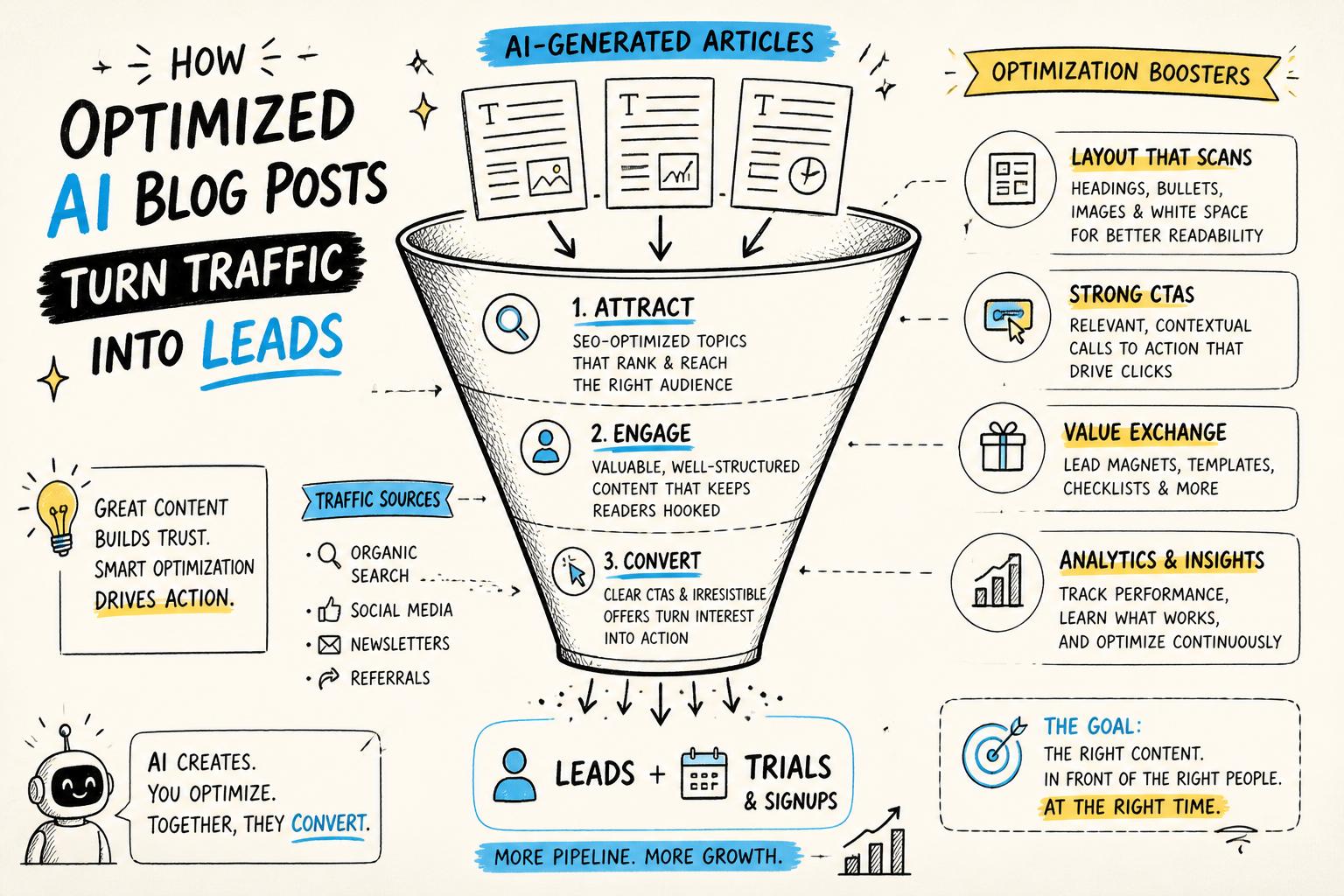
Before you change anything, you need a baseline. For BOFU and MOFU SaaS blogs, meaningful conversions usually include:
Primary conversions: trial signup, demo request, pricing page click, product signup
Secondary conversions: email subscription, lead magnet download, webinar registration
Micro-conversions: time on page, scroll depth, CTA clicks, related-article clicks
Benchmarks vary by industry, but many SaaS blogs sit around 0.5–1.5% session-to-lead. High-performing teams often hit 2–5%+ on BOFU posts when they deliberately optimize.
At minimum, track:
Sessions per post
Primary and secondary conversion rate per post
CTA click-through rate (CTR)
Scroll depth and time on page
If you don’t have this in place yet, start with a simple setup using GA4 or a similar tool and then build it into a blog content analytics workflow that you review monthly.
AI blog writers are great at producing SEO content quickly—but out of the box, they tend to miss conversion details humans add instinctively.
Common issues that suppress conversion rate:
Generic CTAs (e.g., “Sign up today”) that don’t match the reader’s intent
Weak product connection—the article educates but never shows how your product solves the problem
Poor information hierarchy: walls of text, buried CTAs, no clear “what next?”
No segmentation: the same CTA for top-of-funnel readers and sales-ready buyers
The good news: these are fixable with structured prompts, analytics, and a clear optimization process. Supablog, for example, lets you regenerate and A/B test AI sections while tracking performance via AI blog content analytics.
Here are the highest-ROI changes you can make to existing AI-generated posts, in roughly the order we recommend implementing them.
Most “meh” conversion rates come from fuzzy intent. One post tries to do everything: educate, rank, nurture, and sell.
Instead, assign one primary conversion goal per article, such as:
BOFU: “Start free trial” or “Book a demo”
MOFU: “Download template” or “Join email list”
TOFU: “Read related guide” or “Subscribe for updates”
Then adjust the content and CTAs so everything points to that one action.
How to implement with AI content:
Update your AI prompts to explicitly state the primary conversion goal
Ask the AI to propose 2–3 CTA variants tailored to that goal
Remove or demote unrelated CTAs that distract from the main action
Readers skim. Many never reach the bottom of the page. Relying on a single footer CTA is conversion suicide.
Use analytics to check scroll depth distribution. If only 30–40% of users reach 75% scroll, your hero and mid-article CTAs matter far more than your conclusion.
Best practices:
Place a clear primary CTA above the fold for intent-driven posts (e.g., comparison, alternatives, pricing-related topics)
Add a mid-article CTA block after you’ve delivered a key insight or quick win
Use contrasting button colors and action-first copy (“Start your 14-day free trial” beats “Learn more”)
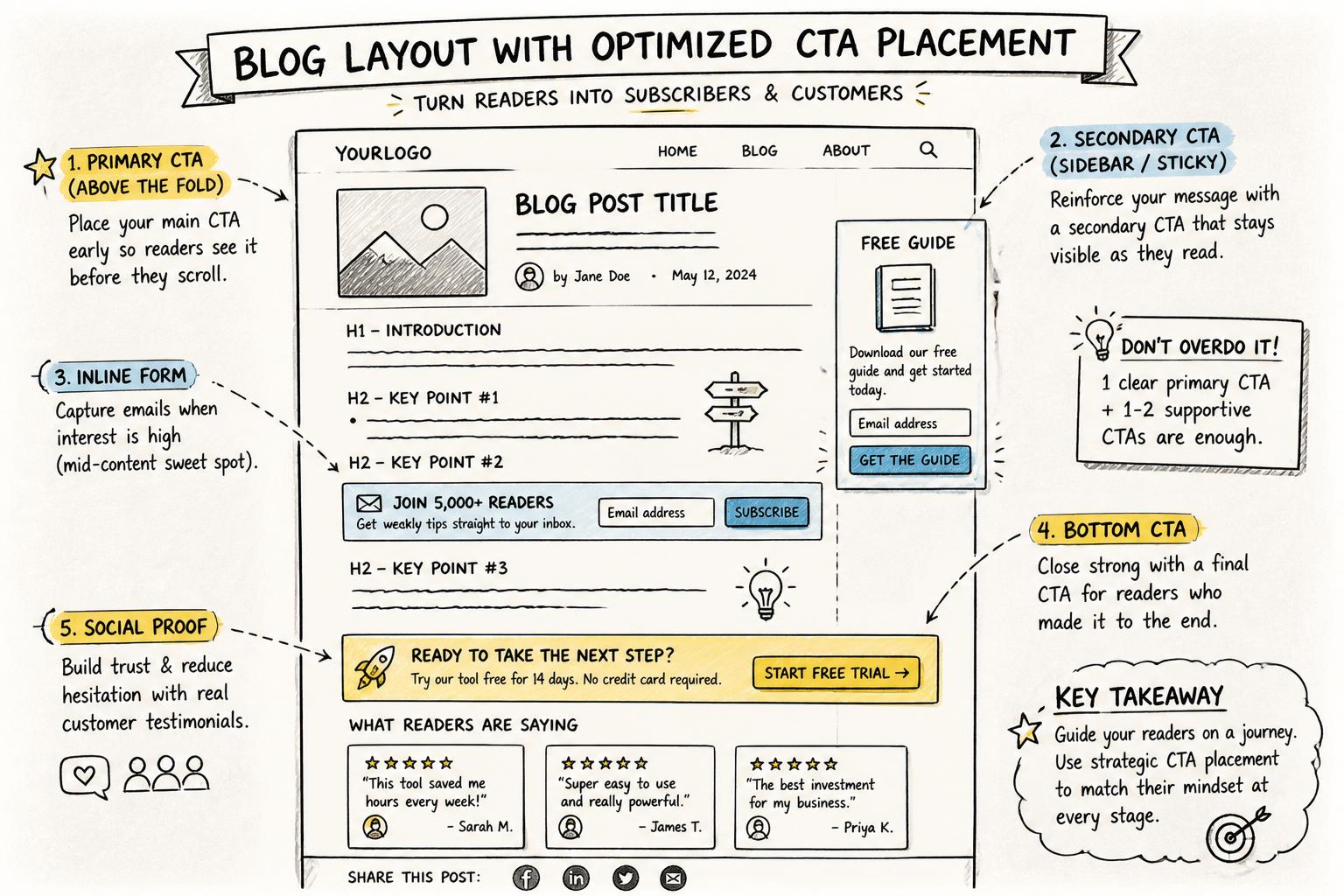
What to measure: CTA CTR by placement (hero vs mid-article vs footer). Move budget and design attention to the spots that actually get clicked.
Two posts can target the same keyword but attract readers at different stages of awareness. A “best AI blog writer tools” post attracts buyers closer to purchase than an “AI content strategy” guide.
Use a simple awareness framework to guide blog CTA optimization:
Problem-aware posts: CTA to educational lead magnet, newsletter, or checklist
Solution-aware posts: CTA to comparison guide, ROI calculator, or webinar
Product-aware posts: CTA to trial, demo, or pricing
In Supablog or other AI tools, you can instruct the model to write CTAs for solution-aware readers and to include soft transitions from education to product.
AI is good at generic how-tos. To increase blog leads, you need specific, product-connected examples.
Instead of:
“Use analytics to see which blog posts convert best, then double down on those topics.”
Try:
“In Supablog, you can see which AI-generated posts drive the most trials, then automatically spin up related articles targeting similar keywords.”
Where to add micro-stories:
After each major tip, add a 2–3 sentence “how we do it with [your product]” example
Use screenshots or short GIFs in high-intent posts
Ask your AI tool to rewrite generic paragraphs as product-anchored stories
This approach not only boosts conversion but also improves content attribution clarity when you later analyze which posts drive pipeline. For a deeper dive, see our guide on content attribution models for blogs.
Banner blindness is real. According to multiple UX studies, users tend to ignore anything that looks like an ad—even if it’s your own CTA block.
Complement banners with natural in-line CTAs woven into paragraphs, such as:
“Teams using Supablog’s AI blog writer publish 30+ optimized posts per month. Start your 14-day free trial to test it on your own site.”
“If you want a ready-made template, download our blog optimization checklist and adapt it to your content calendar.”
Best practices:
Limit to 1–2 in-line CTAs per 1,000 words to avoid spammy feel
Use bold text, not huge buttons, to keep the reading flow natural
Test linking different phrases (benefit-driven vs product-driven) to see what converts
High-intent readers are looking for reasons to believe you. Adding social proof near CTAs can materially improve conversion rates.
Types of proof that work well:
Short testimonial quote from a similar customer
Logos of recognizable brands using your product
Specific outcome metrics (e.g., “42% more leads from blog in 90 days”)
Placement ideas:
Below your hero CTA: one-line proof + logo
Next to mid-article CTA: “Marketers using Supablog cut writing time by 70%”
In the conclusion: 2–3 bullet points summarizing outcomes
According to Nielsen Norman Group’s research on social proof, well-placed testimonials and usage numbers increase perceived credibility and reduce friction for action.
Even strong AI drafts often come out as long, uniform sections. That kills engagement and, by extension, conversions.
Use your analytics to identify posts with:
High traffic but low time on page
High scroll drop-off before the first CTA
Then manually (or with AI assistance) refactor them:
Front-load value: add a short “what you’ll get + who it’s for” section at the top
Turn dense paragraphs into bullet lists and subheadings
Add summary boxes (“Key takeaways”) near your main CTAs
This kind of content conversion optimization often produces quick wins without writing new posts.
You don’t need a full experimentation team to test CTAs. Start with low-lift A/B tests focused on:
Offer: “Start free trial” vs “Get a live demo” vs “See pricing”
Angle: “Publish 30 SEO-optimized posts/month” vs “Cut writing time by 70%”
Risk reversal: “14-day free trial, no card required” vs “Cancel anytime, no contracts”
Use your AI tool for AI content testing by generating multiple CTA variants and rotating them over 2–4 weeks. Track:
CTA CTR
Down-funnel conversion (e.g., trial-to-paid rate) for each variant
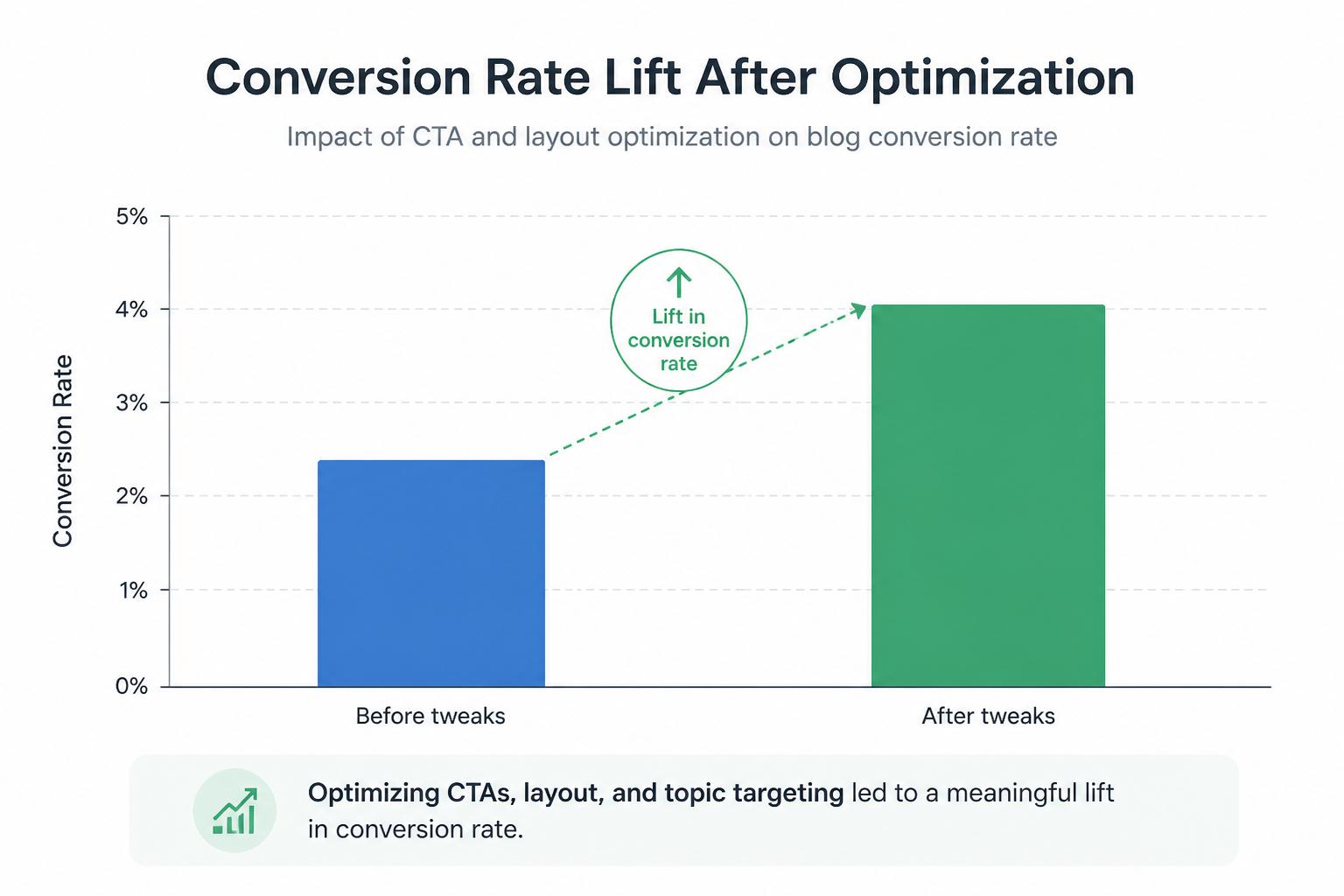
If you’re not sure how to visualize results, build a simple blog analytics dashboard for conversions and track test variants there.
One of the biggest levers for blog funnel optimization isn’t on-page at all—it’s what you choose to write about.
Use attribution data to identify:
Which posts and topics show up most often in journeys that lead to closed-won deals
Which keywords bring visitors who actually sign up, not just read and bounce
Then:
Cluster more content around those high-intent topics
Update existing AI posts in those clusters with stronger product angles and CTAs
Deprioritize topics that bring traffic but no revenue
Our guide on content attribution models for blogs walks through practical ways to connect posts to pipeline using tools you already have.
External research from Content Marketing Institute’s B2B benchmarks shows that top performers are significantly more likely to track content performance against revenue, not just traffic.
If you’re using or considering an AI blogging platform, the tool should do more than just write articles. It should help you improve blog conversion rate over time.
Supablog is built specifically for that:
AI content generation tuned for SEO so you start with search-ready drafts
Automatic keyword research to uncover high-intent topics worth writing about
Blog performance analytics that show which posts drive trials, demos, and revenue
Unlimited AI rewrites so you can rapidly test different CTAs, angles, and layouts
Multi-platform publishing (WordPress, Webflow, Shopify, Framer, and more) to keep your funnel consistent across properties
High-DR backlink exchange to strengthen rankings for the posts that convert best
Teams typically use Supablog to:
Generate 30 SEO-optimized posts per month without adding headcount
Spot high-traffic, low-conversion posts and rewrite them for better performance
Standardize CTA structures and product storytelling across hundreds of articles
Combined with a disciplined AI blog analytics process, Supablog becomes a closed-loop system: generate, publish, measure, and optimize based on real conversion data.
To make these 9 tweaks stick, turn them into a simple, recurring workflow:
Every month, pull a report of posts by traffic and conversion rate
Flag 3–5 high-traffic, low-conversion posts as optimization candidates
Apply 3–5 of the tweaks above (CTA placement, offer, proof, structure, product stories)
Use AI to draft variants, but review manually for clarity and positioning
Re-measure after 30–60 days and document learnings
Over a quarter or two, this process can meaningfully increase blog leads without publishing dramatically more content.
If you want a platform that bakes this workflow into your stack, start a 14-day free trial of Supablog. Generate SEO-focused posts, track how they perform, and systematically turn AI-written content into a reliable source of trials and revenue.
Written by
Pranjal JainFounder of Supablog, Pranjal is a software engineer passionate about building SaaS products that empower founders to grow and scale their businesses. With a strong focus on practical innovation, he creates tools that solve real-world challenges in the SaaS ecosystem. Outside of building and writing, he enjoys reading and traveling, drawing inspiration from new ideas, cultures, and experiences.