Content Attribution Models for Blogs: See Which Posts Really Drive Revenue
Move beyond vanity metrics and learn how to connect blog content to leads, pipeline, and sales using practical attribution models.

Move beyond vanity metrics and learn how to connect blog content to leads, pipeline, and sales using practical attribution models.
Pranjal Jain

Most blogs still live and die by pageviews. But when your CMO or founder asks, “Which posts are actually driving pipeline?” those vanity metrics fall apart fast.
That’s where content attribution models come in. Instead of guessing which articles work, you can connect posts to leads, opportunities, and revenue—and confidently double down on what’s working.
In this guide, you’ll learn how attribution for blogs really works, the pros and cons of different models, and how to pick a practical setup you can actually maintain. We’ll stay focused on blog-specific examples, not generic ad analytics theory.
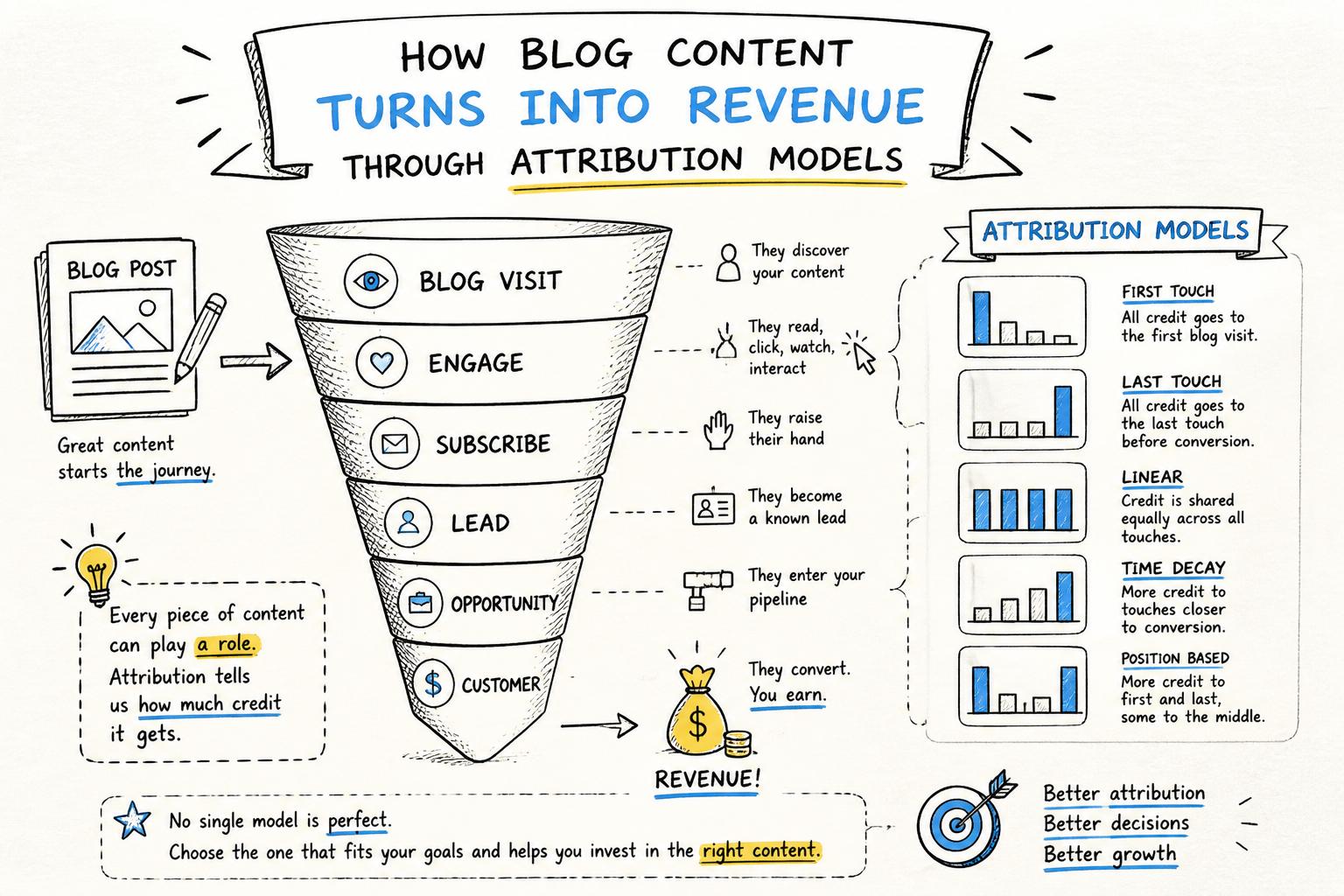
If you’re already tracking performance, you may also want to build a simple blog analytics dashboard that guides content decisions so your attribution insights don’t just sit in a spreadsheet.
Content attribution models are rules for deciding how much credit a blog post gets for a conversion or revenue event.
Instead of saying “this customer saw 7 pages, who knows which one mattered,” an attribution model says, for example:
Give 100% of the credit to the first blog post they landed on
Or split credit across every blog post they touched
Or give more credit to posts closer to the conversion
When you roll this up across all users and all deals, you get a clear view of which posts influence:
New email subscribers
Marketing-qualified leads (MQLs)
Sales opportunities and pipeline
Closed-won revenue
Attribution is part of a broader content marketing analytics stack. If you’re not yet tracking the basics, start with AI blog content analytics to turn data into traffic wins before you jump into multi-touch models.
For top-of-funnel reporting, pageviews and sessions are fine. But they break down once you need to measure content ROI and justify budget.
Here’s why pageviews alone are misleading:
A “viral” post may bring unqualified traffic that never converts
A niche problem-solving article may get low traffic but drive high-intent demo requests
Most users touch multiple pieces of content before converting, especially in B2B
According to Gartner research on multichannel buying journeys, B2B buyers typically interact with a brand across many channels and assets before talking to sales. Your blog is often a quiet but critical part of that journey.
Without attribution, you’ll under-invest in the posts that quietly drive pipeline and over-invest in those that only drive traffic.
A touchpoint is any logged interaction a user has with your content on the path to conversion. For blogs, common touchpoints are:
Landing on a blog post from organic search
Clicking from one blog post to another
Returning to a blog post from an email or social link
Your analytics or CRM needs to capture these and tie them to a user or lead ID.
This is the “success” you want to attribute content to. For mid-funnel (MoFu) blogs, common conversion events are:
Newsletter signup
Lead magnet download
Free trial signup
Demo request
Later, you can extend attribution to opportunities and revenue via your CRM.
The lookback window is how far back you consider touchpoints when assigning credit. For example:
7 days for low-ticket, fast decisions
30–90 days for typical SaaS purchases
Up to 180+ days for enterprise deals
Choosing the right window avoids giving credit to content that is realistically unrelated to the final decision.
Most analytics tools and CRMs support a similar set of attribution models. Here’s how they apply specifically to blogs.
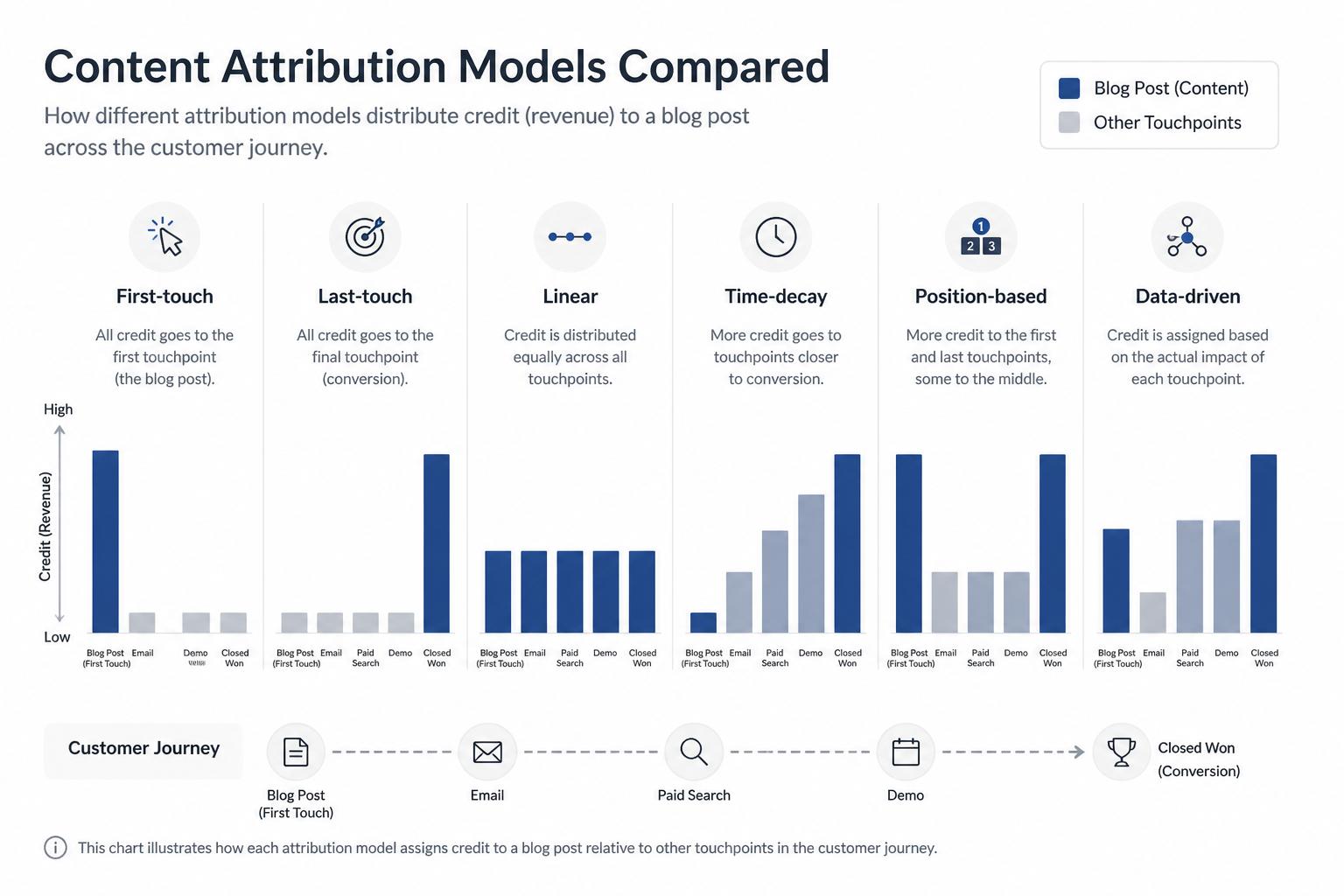
Definition: 100% of the credit goes to the first blog post a user viewed before converting.
Best for:
Understanding which posts attract net-new visitors who eventually convert
Evaluating top-of-funnel SEO topics
Pros:
Simple to implement and explain
Highlights high-performing acquisition posts
Cons:
Ignores all mid-funnel and BoFu content
Over-credits broad, early-stage topics
Blog example: A prospect first finds your site via “What is AI blog automation?” and converts weeks later after reading several case studies. In first-touch attribution, that initial explainer post gets 100% of the credit.
Definition: 100% of the credit goes to the last blog post a user viewed before converting.
Best for:
Understanding which posts directly precede signups or demos
Optimizing conversion-focused content and CTAs
Pros:
Simple and usually available in basic analytics tools
Helps you see which posts nudge users over the line
Cons:
Ignores top-of-funnel content that actually created the demand
Can over-credit “thank you” or pricing-related pages if not filtered
Blog example: A user reads three posts over a month, then converts on “How to measure blog ROI with Supablog.” In last-touch attribution, that ROI post gets all the credit.
Definition: Credit is split equally across all blog posts the user touched within the lookback window.
Best for:
Recognizing that multiple posts contribute to a conversion
Teams that want a fair, “everyone gets some credit” model
Pros:
Captures the full journey instead of one touch
Good default for multi-touch attribution when you lack detailed data
Cons:
Over-credits minor touches (e.g., quick bounces)
Doesn’t distinguish between early and late influence
Blog example: A user reads four posts before requesting a demo. Each post gets 25% of the credit for that conversion.
Definition: Credit is split across all touches, but later touches get more weight than earlier ones.
Best for:
Longer sales cycles where recent education matters more
Balancing early awareness with strong mid- and bottom-funnel influence
Pros:
More realistic than first- or last-touch alone
Still relatively simple to explain to stakeholders
Cons:
Requires more configuration in analytics tools
Weighting choices (e.g., half-life) can feel arbitrary
Blog example: A prospect reads a top-of-funnel post, then a comparison article, then a case study the day before requesting a demo. That case study gets the most credit, but the earlier posts still get some.
Definition: Credit is distributed with extra weight on key positions in the journey, such as first touch, lead-creation touch, and opportunity-creation touch.
Best for:
Complex funnels where you want to highlight critical milestones
Teams that care about both discovery and conversion content
Pros:
More nuanced than linear or time-decay
Lets you emphasize the touches that change funnel stage
Cons:
Requires clear definitions of “lead” and “opportunity” stages
More complex to implement and explain
Blog example: A user discovers you via a “what is” post, becomes a lead after reading a “how to implement” guide, and turns into an opportunity after reading a case study. Those three posts get the majority of the credit; intermediate touches get the rest.
Definition: Machine learning models analyze all journeys and assign credit based on statistical contribution of each touchpoint.
Best for:
High-traffic sites with lots of conversion data
Teams with advanced analytics resources
Pros:
Can uncover non-obvious high-impact posts
Adjusts automatically as user behavior changes
Cons:
Requires significant data volume and tooling
Often a “black box” that stakeholders don’t fully trust
Blog example: Your model may learn that users who read “How to build a blog analytics dashboard” are 3x more likely to become customers—even if that post is rarely first or last touch.
You don’t need a PhD in statistics to get value from attribution. The goal is to pick a model that is accurate enough while staying simple enough to maintain.
Different questions call for different models:
“Which posts bring in new converting users?” → First-touch
“Which posts push people to start a trial or book a demo?” → Last-touch or time-decay
“Which posts contribute across the whole journey?” → Linear or position-based
Write down 1–2 core questions you want attribution to answer. That will keep you from over-engineering.
Use this simple progression:
Early stage / low data: Start with first-touch and last-touch side by side
Growing / moderate data: Add linear or time-decay multi-touch attribution
Advanced / high data: Experiment with position-based or data-driven models
If you’re still getting your basics in place, focus first on tracking and interpreting blog performance metrics. You can layer attribution on top once data quality is stable.
Attribution only works if stakeholders trust it. Before you roll out a model:
Walk sales through 3–5 real customer journeys and how credit would be assigned
Agree on definitions of “lead,” “MQL,” “opportunity,” and “customer”
Document the model in a one-page internal playbook
Consider referencing external best practices, such as Google Analytics’ overview of attribution models, to build confidence.
You don’t need a custom data warehouse to get started. Here are realistic implementation paths.
Modern tools like Google Analytics 4, HubSpot, and many CRMs include basic attribution reports that can be filtered down to blog content.
Typical setup steps:
Ensure all blog posts are tagged consistently (e.g., page path contains /blog/)
Define your conversion events (e.g., signup, demo request)
Use built-in first-touch and last-touch reports to compare results
Export data to a spreadsheet for lightweight analysis
This is usually enough to see which posts influence conversions, even if you’re not doing full blog revenue tracking yet.
To go beyond signups and see pipeline and revenue impact, you need to tie sessions to contacts and deals in your CRM.
Common approaches:
Use native integrations (e.g., HubSpot tracking, GA4 → Salesforce connectors)
Pass UTM parameters and session IDs into form submissions
Store “first-touch blog URL” and “last-touch blog URL” in contact fields
Once the data is in your CRM, you can build reports like:
“Opportunities influenced by blog content”
“Revenue by first-touch blog post”
“Average deal size by last-touch post category”
If you can export user journeys (user ID, page path, timestamp, conversion flag), you can build your own simple models in Google Sheets, Excel, or a BI tool like Looker Studio.
Basic workflow:
Group pageviews by user and session
Filter to journeys that include a conversion
Apply rules (first-touch, last-touch, linear) to assign fractional credit
Aggregate by blog URL, category, or author
This requires some data skills but gives you more control than black-box reports.
Supablog is an AI blogging platform designed to not only help you ship SEO-optimized posts at scale, but also to measure what those posts do for your funnel.
Teams use Supablog to:
Generate and auto-publish up to 30 SEO-optimized blog posts per month
Run blog performance analytics that highlight which topics, formats, and CTAs drive signups and trials
Push content to WordPress, Webflow, Shopify, Framer, and more from one dashboard
Enhance posts with AI-generated images and relevant YouTube videos to boost engagement
While your formal attribution model may live in GA4 or your CRM, Supablog helps you act on those insights by generating more of the content that actually moves pipeline.
If you’re working to improve blog conversion rate with data-backed tweaks, Supablog’s analytics plus your attribution model make a powerful feedback loop.
Attribution is only valuable if it changes what you publish and how you promote it. Here are practical ways to use your findings.
Look for posts that consistently show up in journeys leading to signups, opportunities, and revenue—even if traffic is modest.
Then:
Create follow-up posts and deeper dives on those topics
Turn high-performing posts into webinars, PDFs, or email sequences
Feature them more prominently in navigation and internal links
Identify posts with strong traffic but weak contribution in your attribution reports. These are prime candidates for conversion optimization.
Potential fixes:
Add clearer, more relevant CTAs (e.g., “Start a 14-day free trial” instead of generic “Learn more”)
Align the offer with the post’s topic and intent
Improve internal linking to high-converting mid-funnel content
Pair this with structured experiments and conversion-focused blog optimization to systematically lift results.
By mapping which posts show up at different stages, you can spot missing pieces. For example:
Lots of awareness posts but few comparison or ROI posts
Strong BoFu content but weak educational guides for evaluators
Use these gaps to prioritize new content briefs that support users from first touch to purchase.
Once you know which posts actually drive revenue, you can:
Feature them in paid campaigns and retargeting
Pin them in email nurture sequences
Encourage sales to share them in outreach
This ensures your promotion budget amplifies content with proven impact, not just high vanity metrics.
Attribution can easily become noisy or misleading. Watch out for these issues.
If your tracking is inconsistent, your attribution model will be too. Make sure:
All blog URLs follow a consistent structure
Events and conversions are tagged reliably
Cross-domain tracking is configured if relevant
The Google Analytics developer docs are a good reference for getting technical setup right.
Every model has bias. If you only look at first-touch, you’ll over-invest in awareness content. If you only look at last-touch, you’ll over-invest in BoFu posts.
Solution: Compare at least two models (e.g., first-touch vs last-touch) and look for patterns that hold across both.
Some of your most influential content will never show up cleanly in attribution reports—think Slack shares, screenshots in decks, or podcasts referencing your articles.
Balance quantitative attribution with qualitative feedback from sales calls, “How did you hear about us?” fields, and customer interviews.
If you’re feeling overwhelmed, use this phased approach to implement content attribution models for your blog.
Get tracking in order: Clean URL structure, defined conversions, working analytics.
Start with two simple models: First-touch and last-touch for blog-assisted conversions.
Connect to revenue: Push key blog touchpoints into your CRM and report on opportunities and deals.
Add multi-touch: Layer in linear or time-decay attribution for a fuller picture.
Optimize content: Use insights to prioritize topics, fix weak performers, and guide new briefs.
Scale with AI: Use an AI blogging platform like Supablog to quickly produce and iterate on high-ROI content.
With the right attribution setup, your blog stops being a cost center you have to defend and becomes a proven revenue engine you can confidently invest in.
Written by
Pranjal JainFounder of Supablog, Pranjal is a software engineer passionate about building SaaS products that empower founders to grow and scale their businesses. With a strong focus on practical innovation, he creates tools that solve real-world challenges in the SaaS ecosystem. Outside of building and writing, he enjoys reading and traveling, drawing inspiration from new ideas, cultures, and experiences.